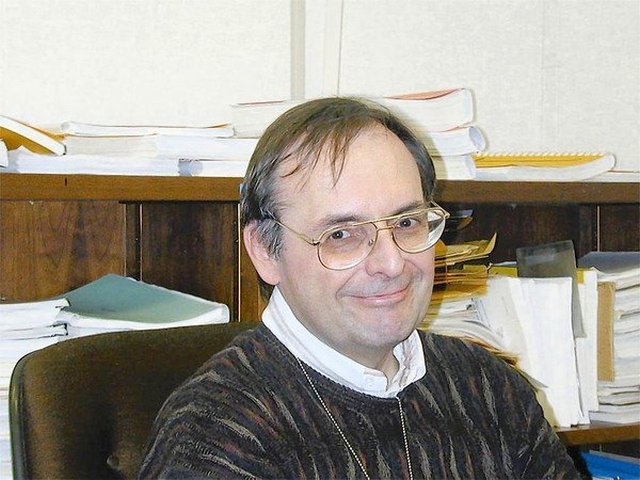
leading engineer in developing the “Sojourner”, “Spirit”, “Opportunity” and “Curiosity” rovers for NASA.
| Jacob Matijevic Jacob (Richard) Matijevic, also known as “Jake” Matijevic, (3 November 1947 – 20 August 2012) was an American NASA engineer of Croatian origin who worked on Mars Exploration Rovers. Dr. Matijevic was involved in developing the “Sojourner”, “Spirit”, “Opportunity” and “Curiosity” rovers. For his contributions to the rover projects, NASA named several landmarks (including “Matijevic Hill” and “Jake Matijevic” rock) for him on the planet Mars. Dr. Matijevic was born and grew up in Chicago, Illinois and graduated from Mount Carmel High School. In 1969, he received a bachelor’s degree in mathematics from the Illinois Institute of Technology, and, in 1973, earned a Ph.D. degree in mathematics from the University of Chicago. In 1981, Dr. Matijevic began working at the Jet Propulsion Laboratory (JPL) in Pasadena, California, as a control systems engineer. In 1986, he worked in the telerobotics field and later, in 1992, began work with the Mars “Sojourner” rover. This rover was delivered to Mars by the Pathfinder spacecraft in 1996. Afterwards, Dr. Matijevic helped develop the “Spirit” and “Opportunity” rovers that began exploring Mars in 2004. He also helped develop the “Curiosity” rover that landed on Mars in August, 2012, just two weeks before his passing. After his death, NASA decided to name a Mars hill, “Matijevic Hill”, encountered by the “Opportunity” rover, and also a Mars rock, “Jake Matijevic”, encountered by the “Curiosity” rover, in his honor for his many contributions to the Mars rover projects over the years. SourceA,A, en.wikipedia.org |
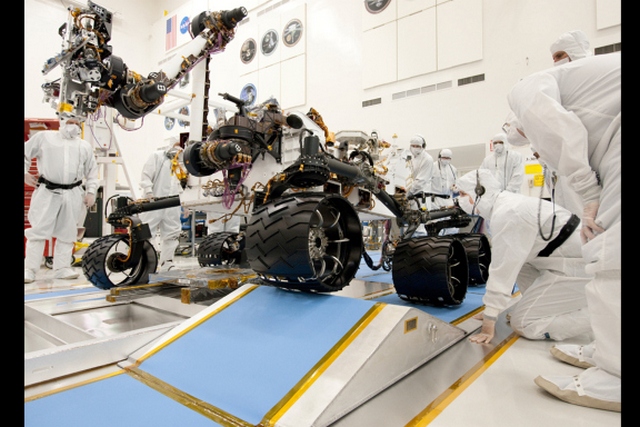

By Jet Propulsion Laboratory, Pasadena, California AcEUR” Published: October 1, 2012
Image credit: NASA/JPL-Caltech/Cornell Univ./Arizona State Univ.
| Jake Matijevic is a pyramidal rock on the surface of Aeolis Palus in Gale crater on the planet Mars The rock was named by NASA after Jacob Matijevic (1947-2012), a mathematician-turned-rover-engineer, who played a critical role in the design of the six-wheeled rover, but died just days after the Curiosity rover landed in August 2012. Matijevic was the surface operations systems chief engineer for the Mars Science Laboratory Project and the project’s Curiosity rover. He was also a leading engineer for all of the previous NASA Mars rovers including Sojourner, Spirit and Opportunity. Mars rover Opportunity working at Matijevic Hill Opportunity has begun investigating the site’EUR(TM)s concentration of small spherical objects reminiscent of, but different from, the iron-rich spheres nicknamed “blueberries”EUR at the rover’EUR(TM)s landing site. NASA’EUR(TM)s Mars rover Opportunity, well into its ninth year on Mars, will work for the next several weeks or months at a site with some of the mission’s most intriguing geological features. The site, called Matijevic Hill, overlooks the 14-mile-wide (22 kilometers) Endeavour Crater. Opportunity has begun investigating the site’ss concentration of small spherical objects reminiscent of, but different from, the iron-rich spheres nicknamed “EURoeblueberries” at the rover’s landing site nearly 22 driving miles ago (35km). The small spheres at Matijevic Hill have different composition and internal structure. OpportunityAcEUR(TM)s science team is evaluating a range of possibilities for how they formed. The spheres are up to about an eighth of an inch (3 millimeters) in diameter. The “blueberries”EUR found earlier are concretions formed by the action of mineral-laden water inside rocks, but that is only one of the ways nature can make small, rounded particles. One working hypothesis, out of several, is that the new-found spherules are also concretions but with a different composition. Others include that they may be accretionary lapilli formed in volcanic ash eruptions, impact spherules formed in impact events, or devitrification spherules resulting from formation of crystals from formerly melted material. There are other possibilities, too. “EURoeRight now, we have multiple working hypotheses, and each hypothesis makes certain predictions about things like what the spherules are made of and how they are distributed,” said Steve Squyres from Cornell University in Ithaca, New York. “EURoeOur job as we explore Matijevic Hill in the months ahead will be to make the observations that will let us test all the hypotheses carefully, and find the one that best fits the observations.” The team chose to refer to this important site as Matijevic Hill in honor of Jacob Matijevic (1947-2012), who led the engineering team for the twin Mars Exploration Rovers Spirit and Opportunity for several years before and after their landings. He worked at NASAAcEUR(TM)s Jet Propulsion Laboratory in Pasadena, California. Source www.astronomy.com |
| Jake Matijevic is a pyramidal rock on the surface of Aeolis Palus in Gale crater on the planet Mars APXS Analyzes Rock Curiosity rover examining “Jake Matijevic” rock (September 22, 2012). The Story of Jake and a Rock on Mars Posted: 09/28/2012 Jake Matijevic, a mathematician-turned-rover-engineer who played an important role in the design of the Mars Science Laboratory (MSL, dubbed “Curiosity”), now appears in Wikipedia as “Jake Matijevic (rock).” Jake passed away just days after Curiosity’s landing in August. With his understated manner, I can imagine his small smile on seeing he’s now more famous as a rock on Mars than as an engineer. Who was Jake and what’s so important about this rock that he would be honored in this way? Jake Matijevic (1947-2012) was the surface operations systems chief engineer for MSL, which means he oversaw all aspects of how Curiosity will be kept alive by the engineers and used to best advantage to carry out the scientist’ two-year exploration of Gale crater and its 3.4 miles (5.5 km) high central mound. Jake was also a lead engineer for the previous Mars rovers — the tiny experimental Sojourner (1997) and the scientists’ durable surrogates in conducting the first overland expedition on another planet, the Mars Exploration rovers, Spirit (2004-2010) and Opportunity (operating even today in Endeavour crater). Jake Matijevic was one of the two engineers I interviewed in studying how it was possible for scientists to conduct field science remotely through a robotic laboratory. Prompted by a suggestion from Steve Squyres, the science principal investigator for MER, Jake helped me understand the engineers’ perspective and their contributions. We met in Jake’s office at the Jet Propulsion Laboratory in Pasadena, CA, in December 2007. He graciously told the story of how the engineers’ thinking has evolved from operating spacecraft like Voyager that fly by a planet or orbit like Cassini around Saturn. Operating a vehicle on the surface is different because you can’t simply write a program months in advance that points instruments and takes photographs or measurements. This realization developed while operating the Viking landers (1976-1980), a pair of stationary laboratories — the scientists could see things they wanted to investigate that were unreachable by Viking’s instruments and shovel. Could you put a moving platform on the surface of Mars? By the late 1990s robotic engineering – a combination of computer programming, power system, instrument miniaturization, and mechanical-electronic control for mobility — made possible the Sojourner experiment, basically a robotic solar panel on wheels carrying cameras and an atomic-spectral analyzer. The mother ship, Pathfinder, also provided a proof-of-concept for the airbag packaging with a bouncing ball landing used by MER. Equally important, the engineering team led by Matijevic and Andy Mishkin figured out how a team with a coordinated work schedule and computer visualization and programming tools could operate the Sojourner rover every day. “Daily commanding” involves receiving data from Mars, processing and interpreting it, deciding what to do next, and then writing and testing a program for the next day’s operation, which is transmitted when the rover wakes up the next morning on Mars. Daily commanding is a huge improvement over Viking, where more primitive tools required about two weeks for a plan to be converted to a program. In effect, Viking operations simply focused on gathering all the data that the instruments allowed. Exploring with a roving laboratory is far more demanding, requiring feedback from prior analyses and movements; for example, you can’t know what interesting and possible to do next without detailed photographs about what’s in your vicinity. Placing an arm with instruments against a rock or soil patch requires knowing how the rover is oriented, so the cameras and other instruments can be placed precisely on the features of interest. Matijevic explained:
As Chief Engineer for MER, a mission that extended Sojourner’s stay from months to years and its under 50 ft (10 m) range to more than 20 miles (34 km), Matijevic and the experienced Sojourner team greatly elaborated how we operate a rover on the surface of Mars. They created a joint science-engineering planning process involving more complex and coordinated instruments (e.g., relating photographs to spectral analyses showing atomic and chemical composition) and planned and conducted “campaigns,” treks and investigations of craters lasting a year or more. These methods, combined with techniques developed on the Phoenix mission (2008) for synchronizing daily operations with transmission of data and commands relayed by satellites orbiting Mars, are used to operate Curiosity today.
In just our short time together, I saw Jake was a humble man, and I later understood well why his passing was felt deeply by all who learned and were guided by him in these pioneering years of working on Mars. |
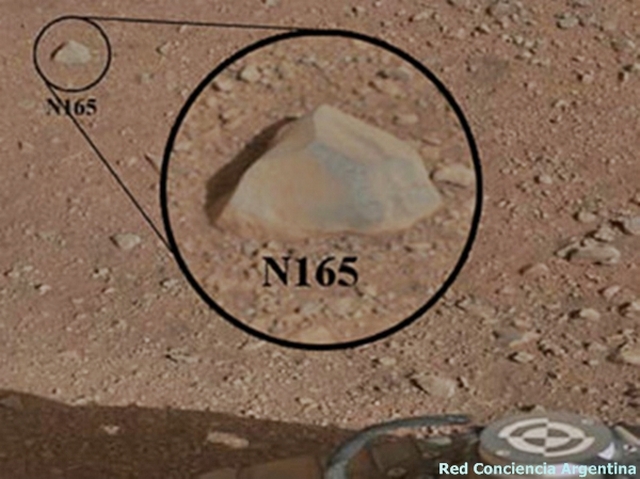

| Washington -EUR” The Curiosity rover is moving across the surface of Mars, approaching its first target to conduct contact science, gathering and analyzing samples of materials. In the true tradition of NASA and the Jet Propulsion Laboratory managing the project, the ground team has named this target Jake Matijevic, honoring a scientist who made significant contributions to the design and engineering of a generation of planetary rovers. Matijevic died two weeks after this Mars Science Laboratory (MSL) touched down on the Red Planet in early August. MSL is also multitasking in its seventh week on the planet. At the same time the craft is preparing to gather data that will give scientists insight into the planet’s geologic history, the craft’s other instruments are looking to the Martian skies to track the movement of Mars’ two moons, Deimos and Phobos. For the first time, humans are getting actual photos AcEUR” by the hundreds AcEUR” of these two satellites as they move across the Martian sky, according to Mark Lemmon of Texas A&M University, Curiosity’s science team co-investigator. The photographic record that MSL transmits back to Earth will allow scientists to take very precise measurements of the orbital patterns of the two moons. They already know that the orbits are changing. “Very slowly over time, Phobos will eventually break up and fall into Mars,” Lemmon said at an online press briefing from JPL headquarters in Pasadena, California. Just as our moon affects the tides on Earth, the Martian moons are also exerting gravitational influences on Mars “ever so slightly,” said Lemmon. While MSL does not have the capability to drill far into the core of Mars, the measurements revealing the lunar influence on the planet will provide some insights into how the planet’s core may be responding, and that may reveal more about the properties of the materials that form the core. Meantime, on the surface, the arms and the instruments of the rover are about to go to work investigating an object that project scientist John Grotzinger calls “a cool-looking rock.” Now known as Jake Matijevic, the rock is 25 centimeters tall and 40 centimeters wide at the base, Grotzinger said, and it’s one that has been detected previously by imaging equipment aboard the Mars orbiters because of its “high thermal inertia.” That term describes the rock’s capacity to retain heat, Grotzinger explained, even when the surface cools off overnight. The orbiters spotted the elevated temperature of this particular rock in contrast to the surface where it rests. This means the rock is made of a material that merits analysis by the sophisticated instruments aboard MSL. JPL engineer Jacob Matijevic was 64 when he died August 20. A 30-year veteran at JPL, he was still working on the latest Mars mission in early August as the MSL spacecraft approached the Red Planet on a journey that began in November 2011. Matijevic was the surface operations systems chief engineer for MSL and the Curiosity rover. He spent most of his career developing Curiosity’s predecessors, which were the pioneer vehicles to serve as surrogates for scientists on Mars. Matijevic was “one of the original technology developers,” according to Curiosity project manager Richard Cook, as NASA engineers first began to dream of sending remote vehicles to other planets. He was a leading engineer on all the rovers that NASA has sent to Mars over the decades, including Sojourner, Spirit and Opportunity. The Sojourner rover, flown to Mars in 1996, was the first to reveal the Martian history as a warm, wet planet. That rover weighed less than 11 kilograms; today’s rover is the size of a compact car, a technological evolution to which Matijevic dedicated his life. “He was probably one of the top one or two surface operations experts here at JPL,” Cook said at the September 19 briefing. In Martian-length days, September 19 was Sol 43 of the rover’s mission, and the craft had traveled almost 300 meters from its landing site. Source iipdigital.usembassy.gov The Curiosity rover is moving across the surface of Mars, approaching its first target to conduct contact science, gathering and analyzing samples of materials. In the true tradition of NASA and the Jet Propulsion Laboratory managing the project, the ground team has named this target Jake Matijevic, honoring a scientist who made significant contributions to the design and engineering of a generation of planetary rovers. |

Opportunity Eyes Rock Fins on Cape York, Sol 3058
Rock fins up to about 1 foot (30 centimeters) tall dominate this scene from the panoramic camera (Pancam) on NASA’s Mars Exploration Rover Opportunity.
Image Credit: NASA/JPL-Caltech/Cornell/Arizona State Univ.
| September 28, 2012 Mars Rover Opportunity Working At ‘Matijevic Hill’ PASADENA, Calif. – NASA’s Mars rover Opportunity, well into its ninth year on Mars, will work for the next several weeks or months at a site with some of the mission’s most intriguing geological features. The site, called “Matijevic Hill,” overlooks 14-mile-wide (22-kilometer-wide) Endeavour Crater. Opportunity has begun investigating the site’s concentration of small spherical objects reminiscent of, but different from, the iron-rich spheres nicknamed “blueberries” at the rover’s landing site nearly 22 driving miles ago (35 kilometers). The small spheres at Matijevic Hill have different composition and internal structure. Opportunity’s science team is evaluating a range of possibilities for how they formed. The spheres are up to about an eighth of an inch (3 millimeters) in diameter. The “blueberries” found earlier are concretions formed by the action of mineral-laden water inside rocks, but that is only one of the ways nature can make small, rounded particles. One working hypothesis, out of several, is that the new-found spherules are also concretions but with a different composition. Others include that they may be accretionary lapilli formed in volcanic ash eruptions, impact spherules formed in impact events, or devitrification spherules resulting from formation of crystals from formerly melted material. There are other possibilities, too. “Right now we have multiple working hypotheses, and each hypothesis makes certain predictions about things like what the spherules are made of and how they are distributed,” said Opportunity’s principal investigator, Steve Squyres, of Cornell University, Ithaca, N.Y. “Our job as we explore Matijevic Hill in the months ahead will be to make the observations that will let us test all the hypotheses carefully, and find the one that best fits the observations.” The team chose to refer to this important site as Matijevic Hill in honor of Jacob Matijevic (1947-2012), who led the engineering team for the twin Mars Exploration Rovers Spirit and Opportunity for several years before and after their landings. He worked at NASA’s Jet Propulsion Laboratory, Pasadena, Calif., from 1981 until his death last month, most recently as chief engineer for surface operations systems of NASA’s third-generation Mars rover, Curiosity. In the 1990s, he led the engineering team for the first Mars rover, Sojourner. A different Mars rover team, operating Curiosity, has also named a feature for Matijevic: a rock that Curiosity recently investigated about halfway around the planet from Matijevic Hill. “We wouldn’t have gotten to Matijevic Hill, eight-and-a-half years after Opportunity’s landing, without Jake Matijevic,” Squyres said. Opportunity’s project manager, John Callas, of JPL, said, “If there is one person who represents the heart and soul of all three generations of Mars rovers — Sojourner, Spirit and Opportunity, Curiosity — it was Jake.” JPL, a division of the California Institute of Technology in Pasadena, manages the Mars Exploration Rover Project for NASA’s Science Mission Directorate in Washington. For more information about Opportunity, visit: http://www.nasa.gov/rovers and http://marsrovers.jpl.nasa.gov . You can follow the project on Twitter and on Facebook at: http://twitter.com/MarsRovers and http://www.facebook.com/mars.rovers . Guy Webster 818-354-6278 Jet Propulsion Laboratory, Pasadena, Calif. [email protected] Source www.legacy.com |
| Dr. Jacob Matijevic professional scientific articles published in the field of Mathematics Estes, Dennis R.; Matijevic, Jacob R.: Local-global criteria for outer product rings. Canad. J. Math. 32 (1980), no. 6, 1353-EUR”1360. Estes, Dennis R.; Matijevic, Jacob R.: Matrix factorizations, exterior powers, and complete intersections. J. Algebra 58 (1979), no. 1, 117-135. Estes, Dennis R.; Matijevic, Jacob R.: Unique factorization of matrices and Towber rings. J. Algebra 59 (1979), no. 2, 387-394. Anderson, D. D.; Matijevic, J. Graded: pi-rings. Canad. J. Math. 31 (1979), no. 3, 449-457. Johnson, Jon L.; Matijevic, Jacob R. Krull: dimension in graded rings. Comm. Algebra 5 (1977), no. 3, 319-329. Anderson, D. D.; Matijevic, J.; Nichols, W.: The Krull intersection theorem. II. Pacific J. Math. 66 (1976), no. 1, 15-22. Matijevic, Jacob R.: Maximal ideal transforms of Noetherian rings. Proc. Amer. Math. Soc. 54 (1976), 49-52. Matijevic, Jacob: Three local conditions on a graded ring. Trans. Amer. Math. Soc. 205 (1975), 275-EUR”284. Matijevic, Jacob; Roberts, Paul: A conjecture of Nagata on graded Cohen-Macaulay rings. J. Math. Kyoto Univ. 14 (1974), 125-128. Source American Mathematical Society, proceed to MathSciNet |
| Alumni Awards 2015 Lifetime Achievement Award The Lifetime Achievement Award is bestowed posthumously on an individual who has recently passed away and who, during his or her life, achieved personal success, made an outstanding contribution to his or her chosen field of endeavor, and achieved recognition by his or her colleagues. Jacob R. Matijevic (MATH ‘EUR(TM)69) Degrees: B.S. Mathematics (‘EUR(TM)69), Illinois Institute of Technology; M.S. (’70), Ph.D. (‘EUR(TM)73), Mathematics, The University of Chicago  Dr. Jacob Matijevic
Career: |
| A,A, Jacob R. Matijevic, 1947-2012 Engineer worked on Mars rover missions October 10, 2012 | By Bob Goldsborough, Special to the Tribune Jacob R. Matijevic was trained as a mathematician and spent time as a math professor, but he found his greatest professional success as an engineer working on exploration projects that studied the climate and geology of Mars. “The Mars rovers that he worked on are very complex systems, and no one person can know the entirety of each one of these systems,” said John Callas, the Jet Propulsion Laboratory’s project manager for the Mars Exploration Rover. “He was the most knowledgeable person on the entirety of the system, so if you had a question, he was the guy to go to.” Source articles.chicagotribune.com JACOB R. MATIJEVIC Guest Book in honour of late Dr. Jacob R. Matijevic |
Formated for CROWN by Darko (R)ubriniae
Distributed by www.Croatia.org . This message is intended for Croatian Associations/Institutions and their Friends in Croatia and in the World. The opinions/articles expressed on this list do not reflect personal opinions of the moderator. If the reader of this message is not the intended recipient, please delete or destroy all copies of this communication and please, let us know!