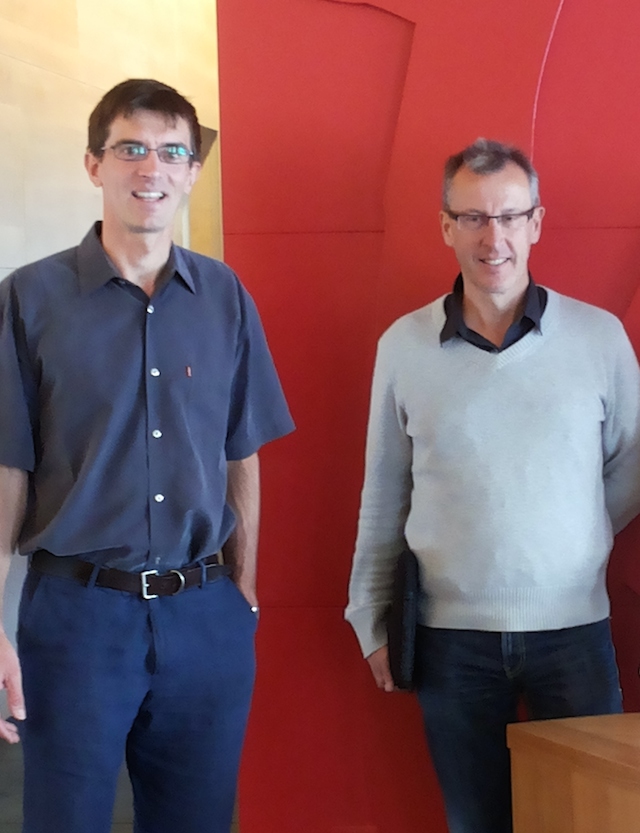
first director of the Basque Center for Applied Mathematics in Bilbao, Spain
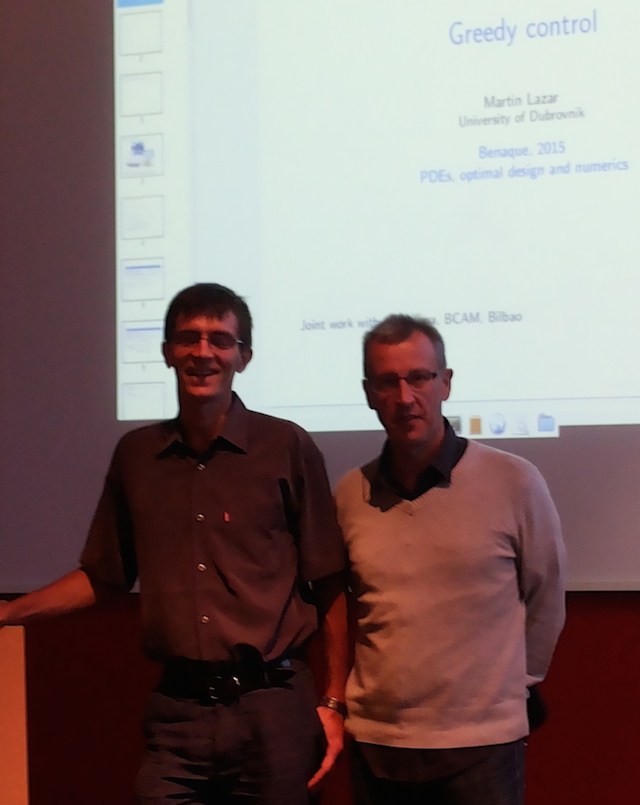
| Summary. In May and June 2015, Dr Martin Lazar, a young Croatian mathematician from the Univeristy of Dubrovnik, visited the Basque Center for Applied Mathematics in Bilbao, Spain, in order to continue already established collaboration with its first director (and founder), Professor Enrique Zuazua. Professor Zuazua is a distinguished international expert in Control Theory, a branch of Applied Mathematics. Dr Lazar had an opportunity to actively participate in numerous activities at the Center (seminars, courses, workshops, …), to present his previous results, as well as to get acquainted with the recent results and open problems of applied mathematics. |
| Razdoblje svibnj – lipanj 2015. proveo sam nekoliko mjeseci kao gostujuaei znanstvenik na Baskijskom centru za primijenjenu matematiku (BCAM), Bilbao, (C)panjolska, gdje sam radio u sklopu znanstvenog projekta Partial Differential Equations: Analysis, Control, Numerics and Applications. Boravak je realiziran na inicijativu osnivaea centra i voditelja projekta, prof. Enrique Zuazua, koji je istaknuti medunarodni struenjak u tom podrueju, i nastavak je na1e uspje1ne suradnje koja je zapoeela 2013. kad sam prvi put gostovao na BCAM-u. Podrueje istra 3/4 ivanja je bila teorija upravljanja (parcijalnim diferencijalnim jednad 3/4 bama), koja je potencijalno jako primjenljiva, buduaei da ispituje moguaenosti i uvjete pod kojima se neki fizikalni sustav mo 3/4 e iz proizvoljnog stanja dovesti do 3/4 eljenog. Posebno, u na1em radu se bavimo upravljanjem parametarski ovisnih sustava i jednad 3/4 bi. Pri tom svo uveli dva nova koncepta: usrednjenog upravljanja i pohlepnog upravljanja. Usrednjeno upravljanje je rezultat mog prvog boravka na BCAM-u u 2013. Ono ispituje moguaenosti upravljanja sustavom kori1tenjem jedinstvene upravljaeke funkcije neovisno o vrijednost parametra o kojem sustav ovisi. Kao primjer koncepta mo 3/4 e poslu 3/4 iti zadaaea upravljanja temperaturom u nekoj prostoriji, 1to je problem koji ovisi o nizu parametra, npr. vla 3/4 nosti. Ako nam je cilj dovesti temperaturu na 22°C, usrednjenim upravljanjem neaeemo to postiaei za svaki indeks vla 3/4 nosti, ponekad aee temperatura biti ne1to ispod 3/4 eljene, ponekad pak vi1a od nje, ali u prosjeku aee ona biti 22°C. Prednost pristupa je 1to omoguaeuje kori1tenje istog upravljaekog sklopa u svim situacijama, te se on ne treba nanovo raeunati i postavljati s promjenom vlage u prostoriji. Pojam usrednjenog upravljanja parcijalnim diferencijalnim jednad 3/4 bama predstavljen je u zajedniekom radu s E. Zuazuom “Averaged control and observation of parameter-depending wave equations” objavljenom u CRAS-u (Comptes rendus de l’Académie des Sciences, Paris) 2014. Pojam je zatim prihvaaeen i dalje razradivan u nizu elanaka. Pri tom u radu primjenjujemo alate mikrolokalne analize, posebno H-mjere koje su bila tema moje disertacije. Na taj naein je do1lo do zgodne simbioze u kojoj smo spojili moje znanje matematieke analize s bogatim iskustvom E. Zuazue iz teorije upravljanja. Drugi novi pristup u analizi sustava koji ovise o jednom ili vi1e varijabilnih parametara (temperaturi, brzini ili sl.) predstavlja pojam pohlepnog upravljanja uveden pro1le godine. Pritom primjenjujemo od prije postojeaeu teoriju pohlepnih algoritama za rje1avanje parametarski ovisnih diferencijalnih jednad 3/4 bi na probleme upravljanja. Pristup omoguaeuje efikasan izraeun upravljaeke funkcije (do na danu toenost) za proizvoljnu danu vrijednost parametra. Pripadni algoritam se sastoji od dva dijela. U prvom, tzv. offline dijelu raeunaju se kontrole za nekoliko najistaknutijih parametarskih vrijednosti, s kojima se zatim aproksimira skup svih moguaeih kontrola. Taj dio je vremenski i raeunalno zahtjevan (jer je potrebno utvrditi koje su to istaknute vrijednosti parametra), ali se provodi samo jednom, te se njegovi rezultati memoriraju. U drugom, online dijelu se pak za danu vrijednost parametra pripadna upravljaeka funkcija aproksimira linearnom kombinacijom kontrola dobivenih u prvom dijelu . Dobiveni rezultati su veae predstavljeni na nizu medunarodnih skupova, izmedu ostalog i na SIAM (Society of Industrial and Applied Mathematics) konferenciji u Parizu u srpnju 2015, na kojoj je prof. Zuazua odr 3/4 ao plenarno predavanje, a pripadni znanstveni rad je trenutno u recenzentskom postupku. Tijekom boravka na BCAM-u sam takoder imao prilike se aktivno ukljueiti u brojne aktivnosti koje se u Centru redovito odvijaju (seminari, teeajevi, radionice itd), predstaviti svoje dosada1nje rezultate i podrueja istra 3/4 ivanja, kao i upoznati se s tekuaeim dostignuaeima i problemima iz primijenjene matematike. Upoznao sam i uspostavio suradnju i s drugim kolegama s kojima trenutno pripremam nekoliko znanstvenih radova. Boravak na jednoj takvoj instituciji, te prilika da kao znanstvenik suradujem s uglednim matematiearima mogu opisati kao jedan intenzivan trening i izvrsnu priliku za profesionalnim usavr1avanjem. |
I spent the period of May-July 2015 as a visiting researcher on the Basque Center for Applied Mathematics (BCAM), Bilbao, Spain, where I was engaged within the project Partial Differential Equations: Analysis, Control, Numerics and Applications. I was invited by the project leader and the first director of the Center, prof. Enrique Zuazua, who is a distinguished international expert in this field. The visit represents a continuation of our previous successful collaboration established during my first stay at BCAM in 2013. The research subject was the control theory – a mathematical branch with a huge application potential that explores conditions under which some physical system can be steered to a desired state. In particular, we investigated parameter dependent systems for which we introduced two novel concepts: averaged control and greedy control. Averaged control investigates the possibilities of controlling a parameter dependent system by a single control function, independent of the parameter value. The problem is relevant in applications in which the control has to be chosen regardless of a particular realisation of the parameter, in a robust manner. As an example one can consider control of a room temperature, which is the problem depending on a number of parameters, humidity for example. If the temperature is to be steered to 22°C, the averaged control will not achieve this goal for every humidity index, sometimes the temperature will be a bit lower, sometimes higher, but on average it will be 22°C. An advantage of the method is that it allows for the same control mechanism which does not have to be adjusted with each change of humidity index in the room. The notion of averaged control for partial differential equations was introduced in the joint article with E. Zuazua “Averaged control and observation of parameter-depending wave equations”, published in CRAS-u (Comptes rendus de l’Académie des Sciences, Paris) 2014. Subsequently, the concept has been accepted and developed in a number of papers. In this article, we use microlocal defect tools, in particular H-measures which were the topic of my dissertation defended at the Univeristy of Zagreb. Another novel approach in analysis of parameter dependent systems depending on one or more parameters is given by the concept of greedy control that we introduced in 2015. The approach provides an efficient algorithm for calculating the control of interest (within some precision) for an arbitrary parameter value. The algorithm consists of two parts. In the first, offline one, the controls are constructed for some distinguished parameter values. That part is computationally expensive (as it requires identification of distinguished values), but it is run only once, and its results are memorised. In the second, online part, given an arbitrary parameter value, the corresponding control is approximately constructed in an efficient manner as a linear combination of controls obtained in the first part. The method represents an application of already existing theory of greedy algorithms for solving parameter dependent differential equations to the control theory. The obtained results have been presented on a number of scientific meetings, including the SIAM (Society of Industrial and Applied Mathematics) conference in Paris 2015, where Professor Zuazua gave a plenary talk. During the stays at BCAM I had an opportunity to actively participate in numerous activities going on at the Center (seminars, courses, workshops, …), to present my previous results and fields of interests, as well as to get acquainted with the recent results and open problems of applied mathematics. I met and established collaboration with other colleagues from different continents, with which I am currently preparing several scientific papers. Here I have to add that, although BCAM is a relatively small and recently established (in 2008) mathematical institute, with its activity and renown it competes with larger institutions with a long tradition (e.g. with the Max Planck Institute for Applied Mathematics, Leipzig, at which I spent the academic year 1999/2000). The stay at such a respectable institution and the opportunity to collaborate with distinguished mathematicians I can describe as an intensive training and an excellent opportunity for professional development. |
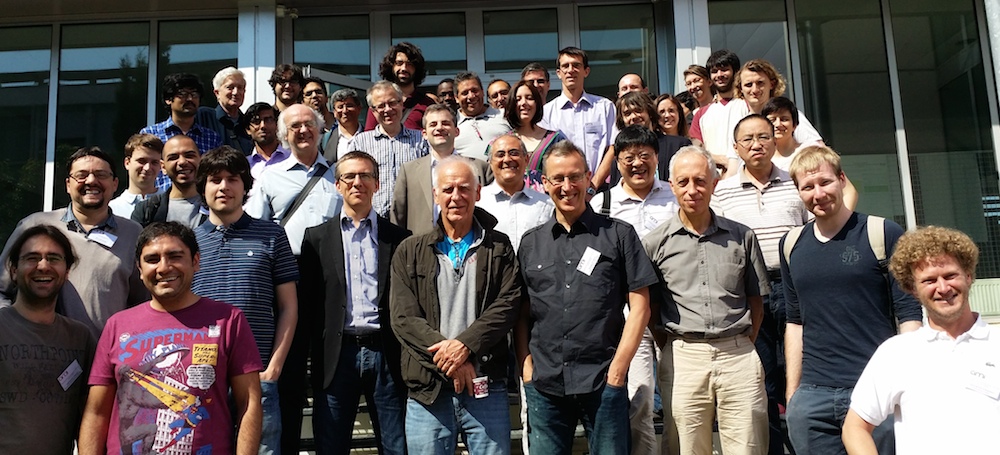
Dr Martin Lazar in the last raw, seventh from the right. Professor Enrique Zuazua in the first raw, fourth from the right.
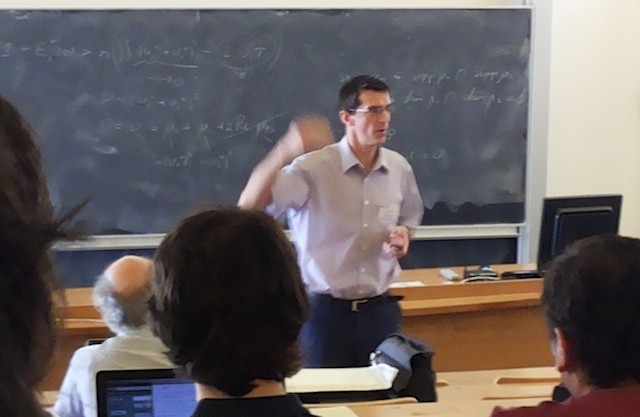

Closing ceremony of the Feast of Sveti Vlaho (St Blaise) in 2016 in the city of Dubrovnik.
Dr Martin Lazar of the University of Dubrovnik is waving (izvija) the banner. Photographer unknown.
Formated for CROWN by Darko (R)ubriniae
Distributed by www.Croatia.org . This message is intended for Croatian Associations/Institutions and their Friends in Croatia and in the World. The opinions/articles expressed on this list do not reflect personal opinions of the moderator. If the reader of this message is not the intended recipient, please delete or destroy all copies of this communication and please, let us know!