

|
Pučko školstvo u hrvatskim zemljama pod Habsburškom Monarhijom nije još bilo organizirano ni u prvoj polovini 18. stoljeća. Katkad su učiteljsku službu obavljali učitelji koje su postavljale općinske vlasti, a katkad župnici. Oni su učenike poučavali čitanju i pisanju, no tek potkraj prve polovine 18. stoljeća zna se da su ih učili i računati.
Sve veće potrebe u trgovini i gospodarstvu prisilili su onodobne učitelje da više pozornosti posvete i računanju. Udžbenici iz računa, međutim, tad su postojali samo na stranim jezicima, a puk je trebalo poučavati na hrvatskome jeziku. Zbog toga je Mijo Šilobod Bolšić napisao prvu aritmetiku na hrvatskom jeziku kajkavskim narječjem koja je tiskana godine 1758. u Zagrebu pod naslovom “Arithmetika Horvatszka”. 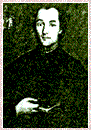 Mijo Šilobod Bolšić Mijo Šilobod Bolšić rođen je 1725. u Svetom Martinu pod Okićem. Gimnaziju je pohađao u Zagrebu, filozofiju izučavao u Beču, a teologiju u Bologni. Bio je župnik u raznim župama u kajkavskim krajevima Hrvatske. Napisao je nekoliko djela raznolikoga sadržaja na hrvatskom i latinskom jeziku, no ipak je najpoznatiji po vrlo opsežnoj aritmetici. Akademik Žarko Dadić, Zagreb
Izvor: Hrvatska pošta |
Public education in Croatian regions under the rule of the Habsburg Monarchy had not yet been organized even in the first half of the 18th century. Sometimes the teaching services had been performed by teachers appointed by municipal authorities and sometimes teaching was done by parish priests. They taught their pupils to read and write and it was only at the end of the first half of the 18th century that it was known of priests who taught their pupils the elementary branch of mathematics.
The growing needs in trade and economy forced the teachers of that time to pay more attention to doing sums and calculations. At that time, however, the only handbooks for mathematical operations existed only in foreign languages while it was necessary to teach the population in the Croatian language. This is why Mijo Šilobod Bolšić wrote his first arithmetic in the Croatian language, more specifically in the Kaikavian dialect, published in the year 1758 in Zagreb, entitled “Arithmetika Horvatszka”. Mijo Šilobod Bolšić was born in the year 1725 in the village Sveti Martin pod Okićem. He attended the gymnasium in Zagreb, studied philosophy in Vienna and continued his studies of theology in Bologna. He served as parish priest in various parishes in the Kaikavian regions of Croatia. Šilobod wrote several works of different contents in the Croatian and Latin languages but had become best known for his very extensive book on arithmetic. In writing his arithmetic handbook Šilobod used some foreign arithmetic books, among them the well known handbook of arithmetic written by the Italian author Giuseppe Maria Figatelli. Šilobod’s handbook is divided into four parts: the first part contains the four mathematical operations: addition, subtraction, multiplication and division; the second part describes all operations with fractions, the third part contains the simple and complex rule of three, and the fourth part contains practical trading accounts, debts, profits, losses, mix calculus and many others. In this fourth chapter there are also some more complex explanations, probably intended for pupils who have already sufficiently mastered the first three parts of the book. At the end of the book, on thirty-six un-paginated pages, we find displayed various practical tables. This entirely defines the task and purpose of this work, i.e. the knowledge of the basic accounts and all the accounts that appear in practical life, particularly in trade. Since the handbook was written in the Croatian language, this is where the Croatian arithmetical terminology appears for the first time. Šilobod had obviously used terms that were already recorded in dictionaries; however, this was entirely insufficient because his needs were much greater. On the other hand, the more complex mathematical terms could not be easily found in dictionaries and they were not used by the wide population. This is the reason that Šilobod found out he was facing a huge problem: it would be the first time to record the existing mathematical terminology in a published book, naturally, in the Kaikavian region for which he had written his handbook. He would then have had to adapt the terminology that had already been present in dictionaries, particularly in the dictionary of J. Belloszténëcz. Afterwards he himself would have had to coin the terms he needed, using the already existing roots of specific words of related meaning in the Kaikavian dialect of the Croatian language. He had obviously coined some names by translating Latin terms that he then adjusted to the Kaikavian expression. Šilobod’s arithmetic has great significance in the Croatian culture, particularly because this is the first arithmetic in the Croatian language: it was the first appearance of the systematically used Croatian mathematical terminology. Besides, the handbook had an important role in the education of the Croatian people at the time when great need occurred for the enhancement of the knowledge of accounting in trade and economy. Academician Žarko Dadić, Zagreb
|
Formated for CROWN by prof.dr. Darko Žubrinić
Distributed by www.Croatia.org . This message is intended for Croatian Associations/Institutions and their Friends in Croatia and in the World. The opinions/articles expressed on this list do not reflect personal opinions of the moderator. If the reader of this message is not the intended recipient, please delete or destroy all copies of this communication and please, let us know!