
Participants of the Conference at the Holy Mass held in the city of Biograd, as well as representatives of the University of Zadar (the oldest Croatian university, founded in 1396)
and of the Matrix Croatica Zadar.
and of the Matrix Croatica Zadar.
| Program of the international conference “The Phenomenon of the Glagolitic Script” Organizers: The city of Biograd and the University of Zadar in cooperation with
 Organizing Committee: Božo Došen, prof., Professor Josip Lisac, Professor Pavao Kero, Dr. Anica Vlašić-Anić, Professor Ivica Vigato, Draženko Samardžić, prof., Ivan Šimunić, prof.
Zadar, May 13th, 2017
|
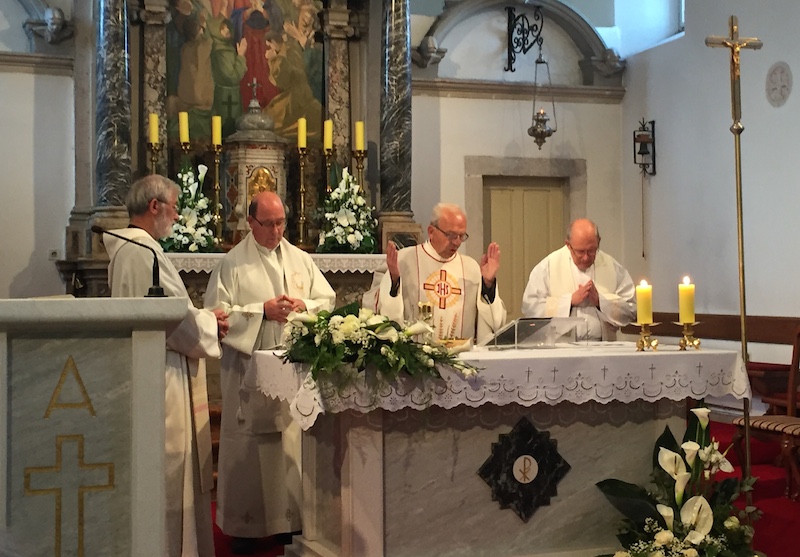
Glagolitic Holy Mass was held in the church of St. Stošija in Biograd. F. Jozo Milanović (benedictine monk in Croatia), Rev. Zdenko Milić, and Dr. fra Izak Špralja leading the Holy Mass.

Božo Došen, prof., at the pulpit of the church of Sv. Stošija in Biograd
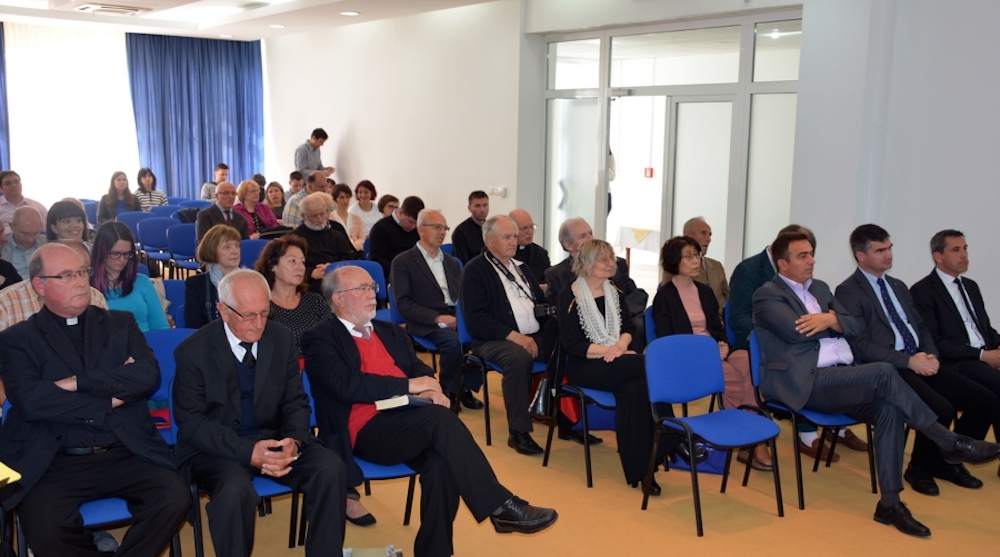
Solemn opening of the Conference in the city of Biograd. Source www.biogradnamoru.hr. The conference was held at the Hotel Adria in the city of Biograd.

F. Jozo Milanović, Croatian benedictine, speaking about the role that his order had in the history of Croatia.
On the right, presiding the session: Božo Došen, prof., Dr. Josip Lisac and Dr. Andrei Sobolev (Russia)
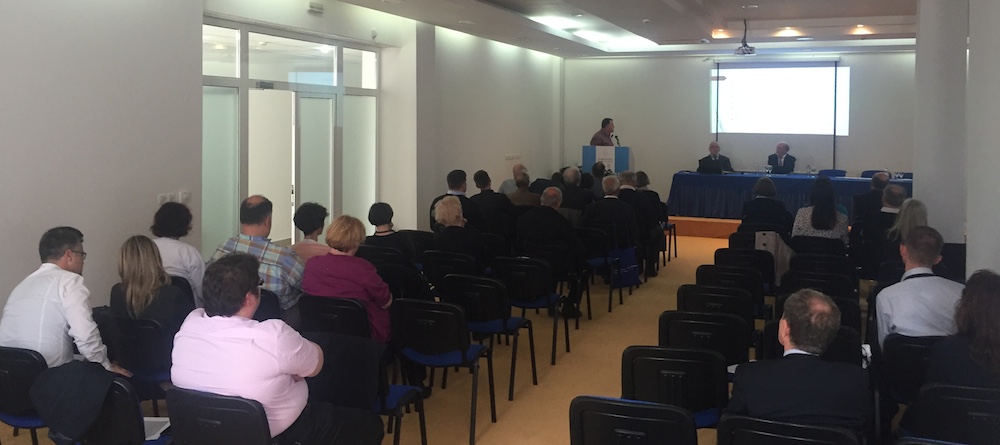
Dr. Ivica Vigato of the Univeristy of Zadar deliverning his lecture.

Professor Keiko Mitani (Tokyo, Japan), with Professors Andrei Sobolev (left, Russia), Draženko Samdardžić (curator of the Biograd Museum), Academician Josip Bratulić,
Božo Došen, prof., and Professor Giorgio Ziffer (right, Italy), in front of the crane, a sign of friendship between the cities of Hiroshima and Biograd. Dr. Keiko Mitani is
president of the Japan-Croatia Friendship Society in Tokyo. The monument contains the following haiku:
Božo Došen, prof., and Professor Giorgio Ziffer (right, Italy), in front of the crane, a sign of friendship between the cities of Hiroshima and Biograd. Dr. Keiko Mitani is
president of the Japan-Croatia Friendship Society in Tokyo. The monument contains the following haiku:
NA KRILIMA LJUBAVI (On the wings of love)
DONESI MIR (bring peace)
GRADU HIROŠIMI (to the city of Hiroshima)
BIOGRAD NA MORU (Biograd on the Sea)
DONESI MIR (bring peace)
GRADU HIROŠIMI (to the city of Hiroshima)
BIOGRAD NA MORU (Biograd on the Sea)

Dr. fra Izak Špralja (former director of the Institute of Church Music in Zagreb), delivering his lecture
on the Glagolitic Singing, which is a unique phenomenon of European music tradition.
on the Glagolitic Singing, which is a unique phenomenon of European music tradition.

Dr. Grozdana Franov-Živković (of the Zadar branch of the Croatian Academy of Sciences and Arts), delivering her lecture
about the content of numerous church records from the Zadar area, written in the Glagolitic Script.
about the content of numerous church records from the Zadar area, written in the Glagolitic Script.

An original Croatian Glagolitic stone monument kept in the Biograd City Museum

The Hotel in Biograd has been totally destroyed during the Serbian aggression on Croatia in 1990s.
The hotel has been constructed by Vagan Melik Karaganjan, important citizen of Biograd of Armenian origin.

Draženko Samardžić, director of the Biograd Museum.

The Biograd Museum is in possession of numerous interesting artefacts, dating from Ancient times as well.

F. Jozo Milanović, Croatian benedictine, in front of the famous Benedictine Abbey of Sts Cosmas and Damian on the island of Pašman.

From left: Academician Anica Nazor, Dr. Keiko Mitani, Dr. Anica Vlašić-Anić, Draženko Samardžić, prof., Dr. Ivan Botica,
Academician Josip Bratulić and F. Jozo Milanović

On the left Dr. Ana Kovačević and Dr. Marija-Ana Duerrigl.

An old photo of the Benedictine Abbey of Sts Cosmas and Damian (end of 19th ct.)

At the Franciscan Convent of St. Domnius in Kraj on the island of Pašman

When St. Francis was in the city of Zadar in 1212, he sent fra Cvitan Floro Zadranin to the island of Pašman to found a Franciscan convent there.

An old icon, kept among many other valuables of the Franciscan Convent.
Please, go to the next page below.
The hotel has been constructed by Vagan Melik Karaganjan, important citizen of Biograd of Armenian origin.
Draženko Samardžić, director of the Biograd Museum.
The Biograd Museum is in possession of numerous interesting artefacts, dating from Ancient times as well.
F. Jozo Milanović, Croatian benedictine, in front of the famous Benedictine Abbey of Sts Cosmas and Damian on the island of Pašman.
From left: Academician Anica Nazor, Dr. Keiko Mitani, Dr. Anica Vlašić-Anić, Draženko Samardžić, prof., Dr. Ivan Botica,
Academician Josip Bratulić and F. Jozo Milanović
On the left Dr. Ana Kovačević and Dr. Marija-Ana Duerrigl.
An old photo of the Benedictine Abbey of Sts Cosmas and Damian (end of 19th ct.)
At the Franciscan Convent of St. Domnius in Kraj on the island of Pašman
When St. Francis was in the city of Zadar in 1212, he sent fra Cvitan Floro Zadranin to the island of Pašman to found a Franciscan convent there.
An old icon, kept among many other valuables of the Franciscan Convent.
Please, go to the next page below.

Draženko Samardžić, prof., delivering a lecture at the main hall of the University of Zadar.
The session has been presided by Dr. Anica Vlašić-Anić, Academician Anica Nazor and Dr. Keiko Mitani.
The session has been presided by Dr. Anica Vlašić-Anić, Academician Anica Nazor and Dr. Keiko Mitani.
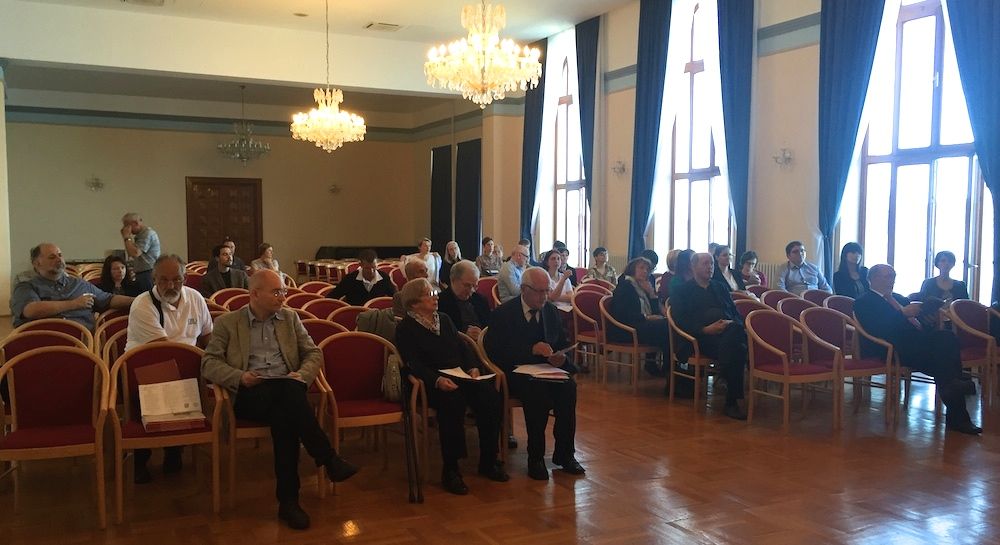
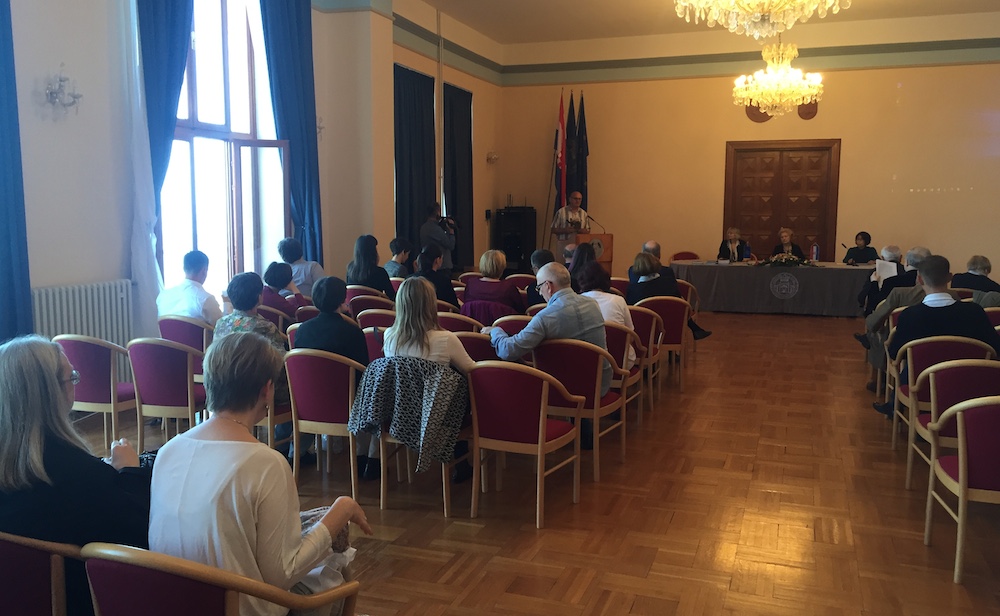

Breathtaking view from the main hall of the University of Zadar to the island of Ugljan. One has a feeling of being on a huge stone vessel.

Dr. Keiko Mitani, Tokyo, reporting about her results on the study of old Croatian Glagolitic manuscripts.

Academician Anica Nazor describing how the Hrvoje Glagolitic Missal from 1404 (kept in Turkey in the Library of Turkish Sultans in Constantinople) was reprinted in 1970s.
On the right Dr. Marijana Tomić, Dr. Tanja Kuštović and Professor Mateo Žagar.
On the right Dr. Marijana Tomić, Dr. Tanja Kuštović and Professor Mateo Žagar.


Dr. Marijana Tomić reporting about her current work on pisanabastina.unizd.hr, dealing with the use of computer technologies in linguistics.
An important Croatian Glagolitic condex from the 15th ct, which is a part of the Berčić Collection kept in the Russian National Library in St. Peterburg, has been reprinted in 2016 in cooperation with the mentioned library with the Permanent Exhibition of Church Art in the city of Zadar, Croatia: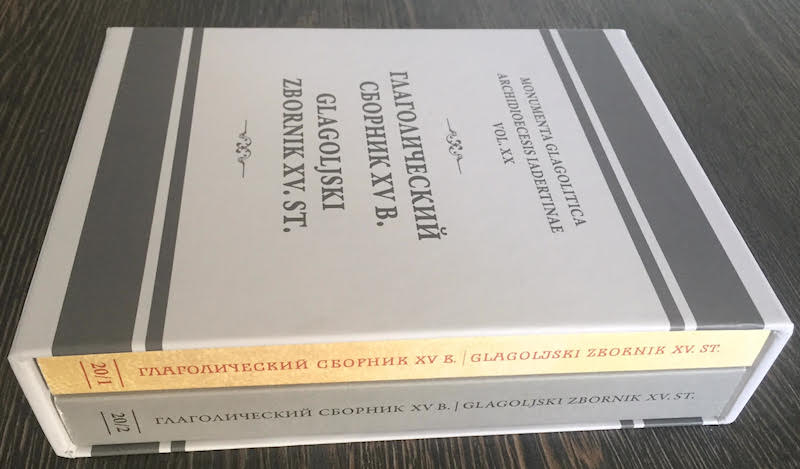
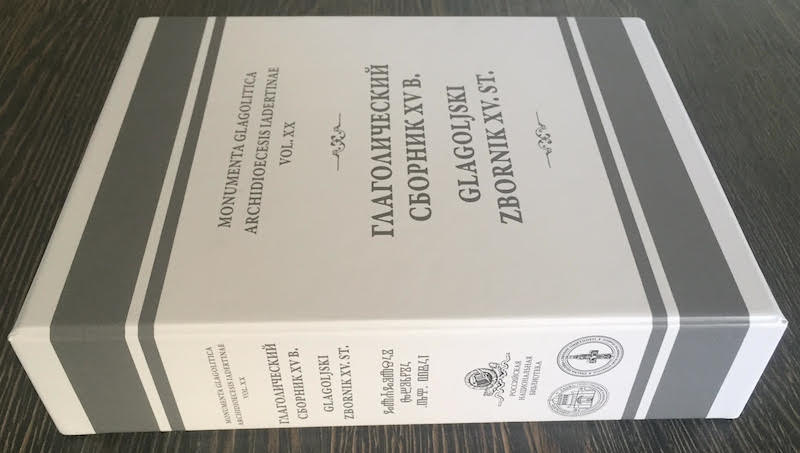
An important Croatian Glagolitic condex from the 15th ct, which is a part of the Berčić Collection kept in the Russian National Library in St. Peterburg, has been reprinted in 2016 in cooperation with the mentioned library with the Permanent Exhibition of Church Art in the city of Zadar, Croatia:
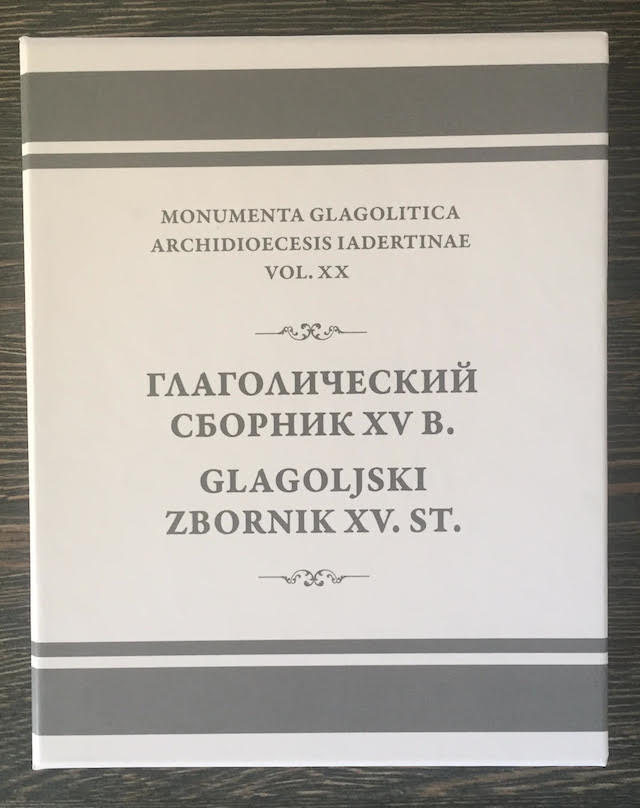
Monumenta glagolitica Archidioecesis Iadertinae Vol. XX / Glagoličeskij sbornik XV v. / Glagoljski zbornik XV. st., Zadar 2016. ISBN 978-953-331-146-3, ISBN 978-953-331-147-0
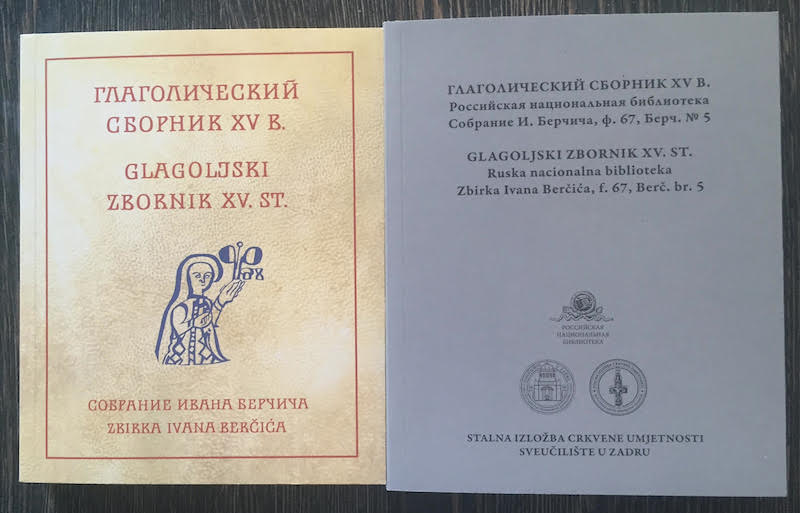
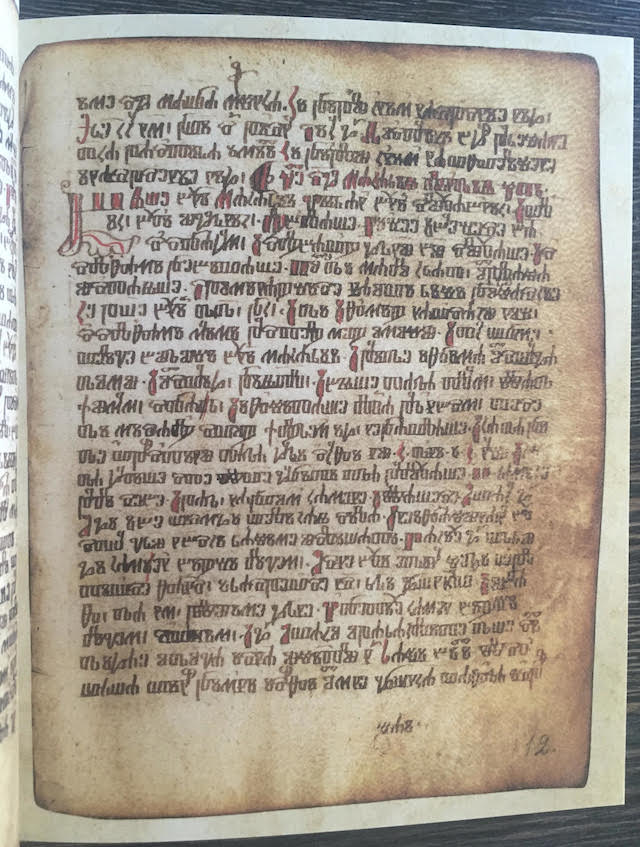
Dr. don Pavao Kero, jointly with a group of his colleagues, initated an important project of reprinting church records and glagolitic miscellania from the Zadar region, acompanied with scholarly studies, which has already resulted in impressive series of as many as 21 volumes (consisting of 26 books). The common title of the series is
Monumenta glagolitica Archidioecesis Iadertinae
Tu treba dodati i
For more information see Udruga glagoljaša Zadar |

Lunch in the open, by the sea and with a view to the island of Ugljan.

Fantastic Croatian Glagolitic monument from 1426, discovered in the vicinity of the city of Zadar,
and exhibited within the permanent exhibition of Gold and Silver of the Zadar Archbishopric.
and exhibited within the permanent exhibition of Gold and Silver of the Zadar Archbishopric.
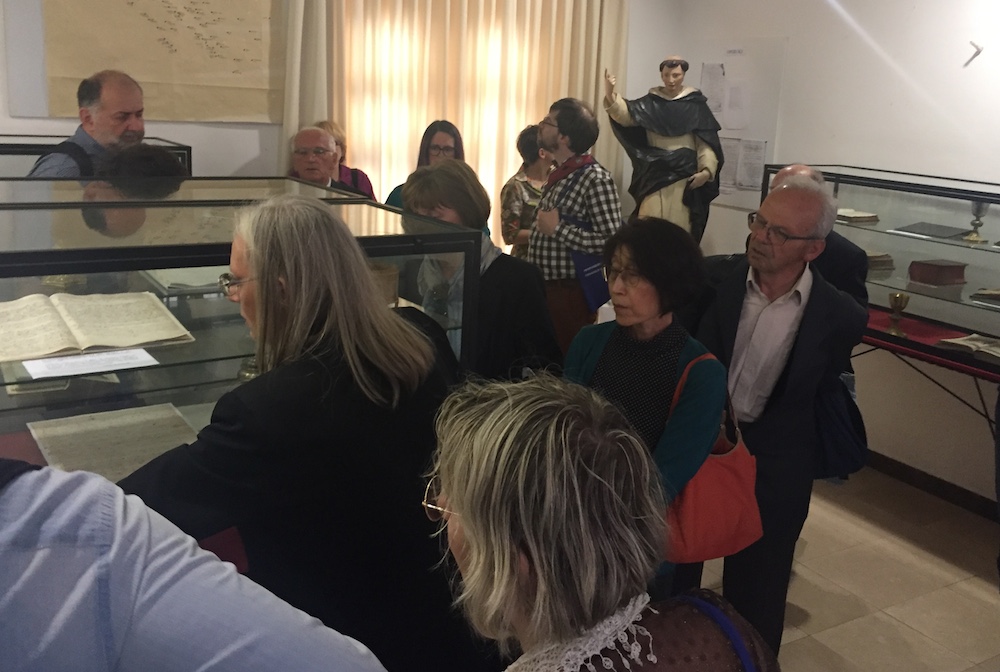
Exhibition of selected legal documents (mostly church records) and books, written in the Glagolitic Script,
kept within the Permanent Exhibition of Church Art in the city of Zadar.
kept within the Permanent Exhibition of Church Art in the city of Zadar.

Dr. don Pavao Kero, director of the Exhibition of Church Art in Zadar, with Academician Anica Nazor.
Between them can be seen Dr. fra Izak Špralja, who is an expert for church music.
Between them can be seen Dr. fra Izak Špralja, who is an expert for church music.

On the left, Zrinka Vitković (Library of the Croatian Academy of Sciences and Arts) with Dr. don Pavao Kero,
Božo Došen, prof., and Academician Anica Nazor.
Božo Došen, prof., and Academician Anica Nazor.

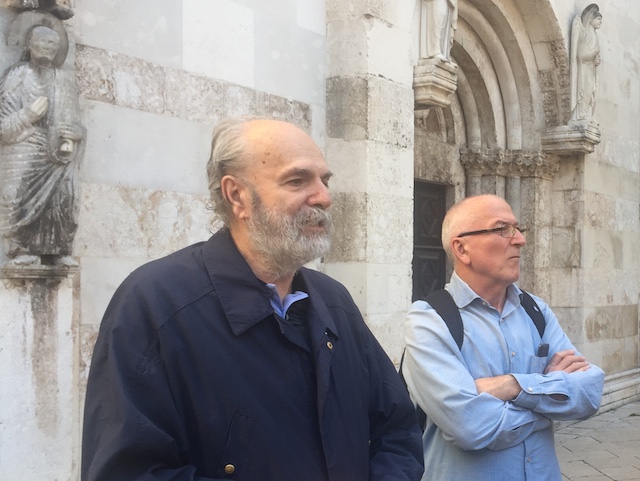
Dr. Radomir Jurić, former director of the Archaeological Museum of the city of Zadar.
Next to him is Dr. Milan Mihaljević from the Old Slavonic Institute in Zagreb.
Next to him is Dr. Milan Mihaljević from the Old Slavonic Institute in Zagreb.

One of the Zadar streets bears the name of Šimun Kožičić Zadranin (nicknamed Benja),
who was a bishop and owner of the glagolitic printing house in the city of Rijeka.
who was a bishop and owner of the glagolitic printing house in the city of Rijeka.

Benedictine Abbey of Sv. Krševan (St. Crysogonus) is one of the most important cultural monuments of the city of Zadar.
Between 9th and 12th centuries, Croatia used to have as many as 120 benedictine abbeys, mostly along the Adriatic coast.
Between 9th and 12th centuries, Croatia used to have as many as 120 benedictine abbeys, mostly along the Adriatic coast.

The Concert Hall of the city of Zadar, as described by Dr. Radomir Jurić, has been completely destroyed during
the Serbian aggresion on Croatia in the 1990s. It is a part of Rector’s Palace.
the Serbian aggresion on Croatia in the 1990s. It is a part of Rector’s Palace.


Dr. Anica Vlašić-Anić was one of the organizers of very successful international conference held in Biograd and Zadar.
Please, go to the next page below.

Some of the artefacts exhibited at the Museum of the Maškovića han. On the left Dr. Anica Vlašić-Anić,
Dr. Marija Ana Duerrigl and Dr. Antonija Zaradija Kiš.
Dr. Marija Ana Duerrigl and Dr. Antonija Zaradija Kiš.

Spectacular arial view to the Vrana Lake, behind which can be seen the sea and the Kornati National Park, containing numerous smaller islands.
On the bottom left can be seen the ruins of the Old Fortress of Vrana, and just next to it (to the right) the Maškovića han.
On the bottom left can be seen the ruins of the Old Fortress of Vrana, and just next to it (to the right) the Maškovića han.

In the renovated Maškovića han near the Vrana Lake.

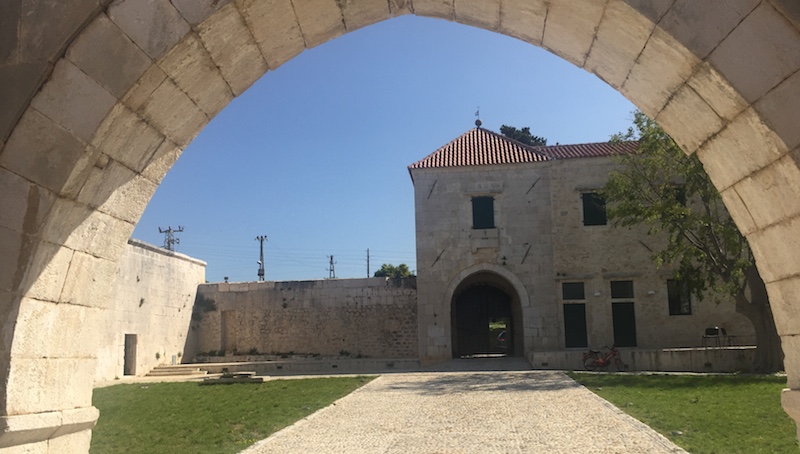

Interior of the Maškovića han.
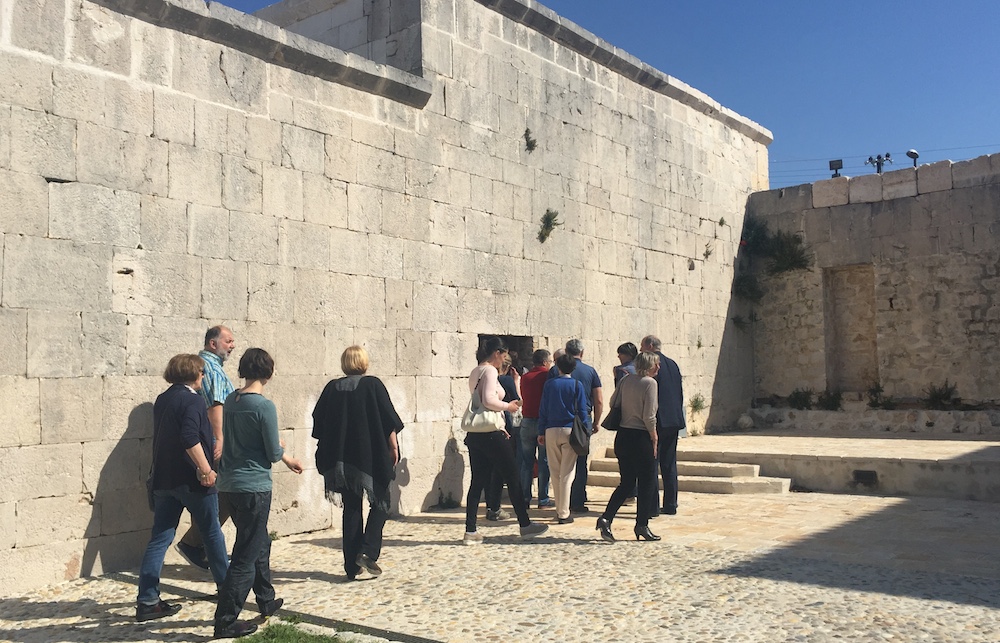
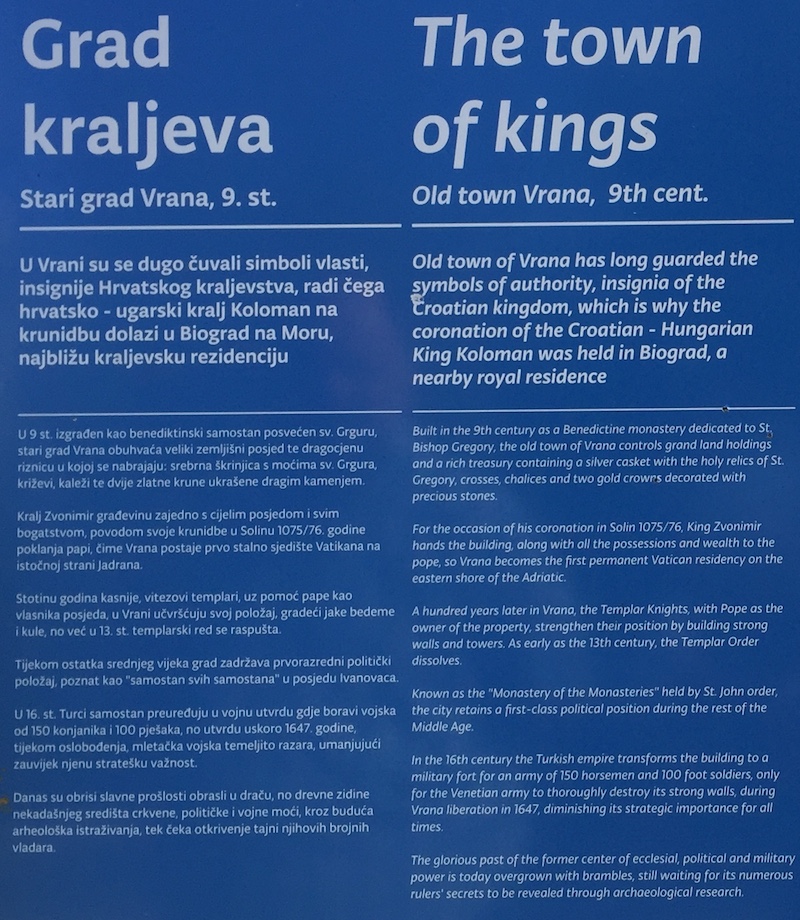
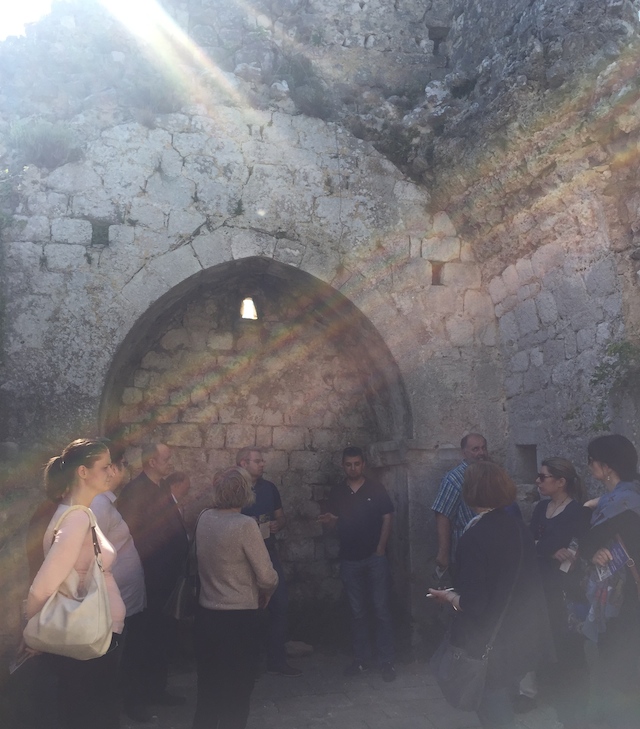
An interesting church inside the Fortress of Vrana, which is still left unexplored.


The end.
Formated for CROWN by Darko Žubrinić
Distributed by www.Croatia.org . This message is intended for Croatian Associations/Institutions and their Friends in Croatia and in the World. The opinions/articles expressed on this list do not reflect personal opinions of the moderator. If the reader of this message is not the intended recipient, please delete or destroy all copies of this communication and please, let us know!
Distributed by www.Croatia.org . This message is intended for Croatian Associations/Institutions and their Friends in Croatia and in the World. The opinions/articles expressed on this list do not reflect personal opinions of the moderator. If the reader of this message is not the intended recipient, please delete or destroy all copies of this communication and please, let us know!