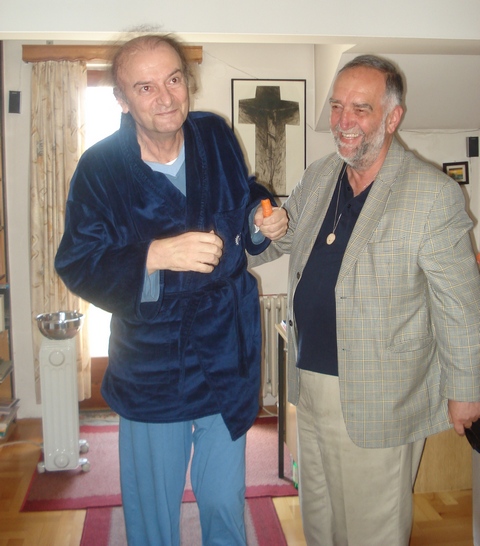
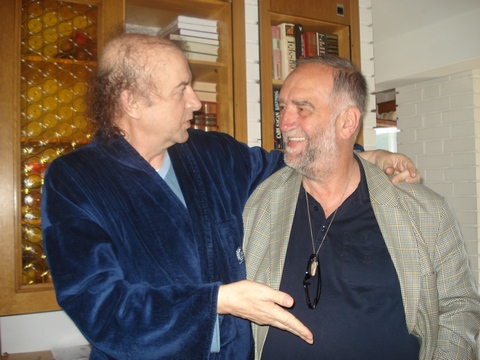
Fra Franjo Grebenar died in December 2010. Photos in June 2010 by D.(R).
A, 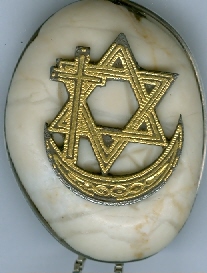 |
A, 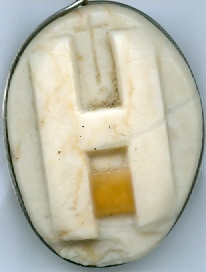 |
A, 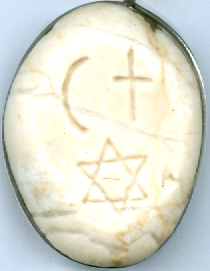 |
Bosnia and Herzegovina, as well as Croatia, is a multireligious country – with Christian, Muslim and Jewish populations being represented.
These are the chains that dr. Slobodan Lang is wearing around his neck, see on the above photos.
In the middle is the symbol of the Croatian Hospital in Nova Bila, designed by dr. Lang himself.
Photos by the courtesy of dr. Lang.
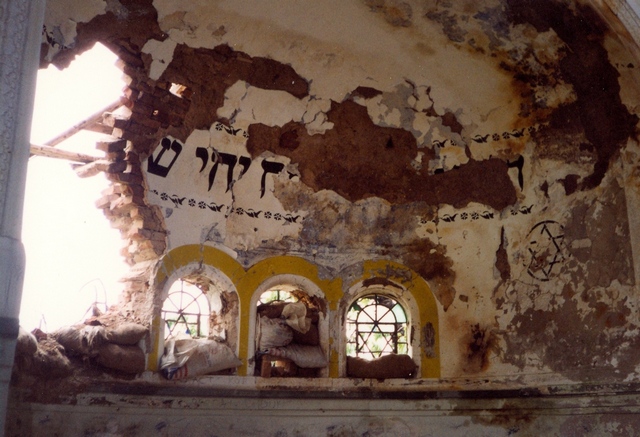
Photo by the courtesy of dr. Slobodan Lang.
| A,Â
White Road for Nova Bila and Silver Bosnia: Humanitarian work has always been an inseparable part of a war, particularly in our times, when technology of information spreads the news on the sufferings of those endangered by war throughout the world. Regardless of the ambiguity of the world’s politics, disorganization of the warring sides and general confusion and complexity surrounding the armed conflict in Croatia and Bosnia and Herzegovina (BH), humanitarian work accompanying the conflict received an immense humanitarian attention and help (1). We will describe here a single humanitarian action, a single convoy, believing that it deserved attention for several reasons: (a) it concerned a completely surrounded community, neglected by international humanitarian organizations and abandoned by those who wanted to help but were unable to do so (Croatian Republic of Herzeg-Bosnia); (b) it was the fastest organized and largest nongovernmental humanitarian help organized in Croatia; (c) it involved an interesting combination of the two leading groups, physicians and Franciscan monks; (d) it passed through numerous troubles and perils which revealed the roles and relationships of the warring sides in BH; (e) it was attacked and saved, one man was killed and five wounded; (f) it marked the great turn in the history of Croatian nation because it was the first aid that started from the capital city of Zagreb and reached Central Bosnia; (g) a part of its organizational scheme branched into the office of the Croatian Medical Journal, which both makes us proud and prompts us to report on the event on these pages. Background After the outbreak of the armed conflict between Croats and Muslims of BH in April 1993, Croats of Central Bosnia were surounded by 6 to 10-fold more numerous Muslim forces into several enclaves (2,3). The largest enclaves were Usora (population 18,000), (R)epee (population 35,000), Vare1 (population 7,000, occupied in October 1993), Novi Travnik-Nova Bila-Busovaea-Vitez (population 70,000) and Kre1evo-Kiseljak (population 36,000) (Fig. 1, ref. 2). More than busy with Muslim attacks on Mostar and North Herzegovina, exhausted by the year-long war against Serbian aggression in BH, poorly organized and rejected by the international community, Croatian community of BH, self-proclaimed first as Croatian Community Herzeg-Bosnia and later as Croatian Republic Herzeg-Bosnia, was unable to either break through Muslim lines or to negotiate the supply of food and medicines to the enclaves which formally were under its care and jurisdiscion. The Republic of Croatia, itself devastated by the 1991/92 Serbian aggression, accused for certain forms of help to Croats of BH, under constant threat of sanctions, was unable to reach Central Bosnia by any means. International community, from the UN to the last humanitarian organization did not want to hear about the sufferings of Croats in Central Bosnia (2-4). Some day this attitude should be carefully analyzed and the general context of the injustice clarified. Action White Road for Nova Bila and Silver Bosnia All Croats were aware of the situation of their compatriots in Central Bosnia but, as explained, all different groups were actually unable to act effectively and/or believed it was the duty and responsibility of others. By the end of October 1993, Dr. Slobodan Lang (5-7) initiated a nongovernmental, independent action aimed to help Croats and all other suffering peoples of Central Bosnia. The idea was based on already existing improvised hospital situated in the Franciscan church Holly Ghost in the small village of Nova Bila, near Novi Travnik. The hospital was formed on Human Rights Day 1992, by local physicians and Franciscans, with Dr. Lang’s involvement. After six months of Croatian-Muslim fighting and Croatian defeats (Fig. 1), the hospital remained the only humanitarian and medical resort for 70,000 encircled Croatians in the area.
Nova Bila The area is approximately 12 km long and 1.2 to 6 km wide (fig. 2). Out of its 70,000 inhabitants, 12,500 are children, 20% displaced persons from other parts of BH and 40% women. Each point of the enclave can be reached by rifle fire of Muslim fighters on the mountains surrounding the valley of La1va (from Novi Travnik on the north to Kaonik on the south, Fig. 2). The enclave itself contained two small Muslim-held enclaves, the Old Vitez (a part of the town of Vitez) and the village of Kru1eica. The food and medicines were short. There were dozens of wounded children, some wounded and 10 killed by sniping rifle fire. Local authorities issued numerous appeals to Croats and to international community but in vain. The turning point was when a human rights activist of Herzeg-Bosnia, Mr. Ante Damjanoviae, managed to get in and out of the enclave and brought the alarming first-hand news to Zagreb. His teacher, Dr. Lang, helped him meet Croatian officials and other important figures on October 29, 1993, and appear live on Croatian TV.
The Action In a TV show on October 31, 1993, Dr. Lang advised all those who wanted to help to contact Dr. Ana Maru1iae at the CMJ. The next morning the work on CMJ had to stop because both telephones constantly kept ringing, offering all kinds of aid, from all sides of the world, Croatia and BH. One of the calls (Mr. Juraj Bokuniae) offered an office in Zagreb, Ilica 128, and a dozen of people met there the next day. The Action White Road for Nova Bila and Silver Bosnia was founded (8). The expression Silver Bosnia was chosen to honour the contribution of Franciscans, because it is their ancient name for Central Bosnia. Soon, the founding members of the Action brought in their friends and the news spread like thunder. The aid started pouring in, threatening to flood us. Fortunately, many people with different skills joined the Action and we were able to cope with all challenges. Essentially, the Action worked through a Council and its 16 Committees, of which most did a splendid job. It was decided that the Action’s convoy will start on the Human Rights Day, December 10, 1993. Owing to great organizational talent and heroic efforts of Mr. Herman Vuku1iae, the Convoy was ready and started as scheduled. The Convoy The journey, all accompanying events and data on the Convoy are not systematized yet, and the details differ from a witness to a witness, depending to his/her position in the Convoy and the fate of that part of the Convoy. Here we will try to give a cross section picture, a summary of all available data. The aim of the Convoy was to reach Croats of the Nova Bila enclave with food, medical aid and equipment for the Franciscan hospital. A part of the aid was aimed for (a) hospital in Muslim-held town of Zenica, (b) small Jewish community in Zenica, (c) Muslim (sub)enclaves in Old Vitez and Kru1eica. At its start, the Convoy was approved by the BH government (Mr. H. Silajd`iae) and Army (General Rasim Deliae). Bosnian Embassy in Zagreb not only fully supported the Convoy but was prompted to organize own convoy in Split, aimed to Muslims in Maglaj. In a friendly atmosphere, a part of this convoy was aimed for Croats in the Nova Bila enclave. It is really unfortunate that these beautiful plans soon turned into a series of tragic events, failing to fulfill most of their goals.
Through Croatia and Free Parts of Herzeg-Bosnia The Convoy started from Zagreb with 38 5-12 tons trucks, a gasoline truck, two accompanying vehicles and a bus with medical personnel, Franciscans and newsreporters (some 50 persons). The Convoy was officially led by Dr. S. Lang and commanded by Mr. H. Vuku1iae. After a small but moving ceremony at Zagreb’s West Train Station at noon on December 10, 1993, the Convoy reached Rijeka in the late evening. There it spent the night, accepted four new trucks and in the morning headed for Split. The weather was bad, storm and occasional Serbian fire followed the Convoy across the Maslenica pontoon bridge. In return, the reception in Split was overwhelming. New 40 trucks and additional volunteers doubled the size of the Convoy. On December 12, 1993, it left Split for Tomislavgrad (BH), which it reached safely on the evening of the same day. From there, troubles followed the Convoy until its return from the mission. Muslim military authorities requested new negotiations, which included Croatian Defense Council (CDC, army of the Croats in Herzeg-Bosnia) and Dr. Lang. Fortunately, Dr. Lang realized that the Muslim side was saving time for Muslim convoy to get prepared in Split. Thus, our Convoy waited for the Muslim one in the Rama Valley, making the final preparations and checks, honored by immense love, attention, care and prayers of the Croats of Rama. The implicit conditioning of our passage by waiting for Muslim convoy is in contrast both to the international rules and to our previous agreements on the unconditional passage of humanitarian convoys. However, that moment was not suitable for moral disquisitions, and the Convoy (a) waited patiently for the Muslim convoy to reach Rama and (b) negotiated (Dr. Lang) incessantly to get the permission and protection to enter the Muslim-held territory which stretched from Gornji Vakuf to Novi Travnik (Fig. 2).
On the Muslim-held Territory At 6:15 on Saturday, December 18, 1993, 92 vehicles with nearly 1,000 tons of aid crossed the front line towards Muslim-held land. Along the first kilometer of the Muslim territory, before Muslim Military Police took over the protection of the Convoy, some 30 trucks were looted by persons in Muslim Army uniforms. Men would jump on the truck, point the guns and fastly rob the travellers of all movable goods and money. UNPROFOR escort in the front and at the end of the Convoy saw this and did nothing. Afterwards, all until Pavlovica, Muslim MP gave the Convoy a perfect protection.
Pavlovica The searching check-point was the village of Pavlovica (Fig. 2). Gen. Deliae ordered and promised that the search would end until 15:00 of the same day. It did not, but lasted until the night; thus the Convoy had to spend the night in open fields, guarded by Muslim MPs who really protected the Convoy from looter, even by shooting at them and arresting them during the day. During the night, however, the looting continued. In the meantime, the Muslim convoy slowly reached the front line (due to the technical problems). Muslim media accused Croats for slaughtering the drivers (in Tomislavgrad), looting the convoy (in Prozor), etc., although just the opposite was true: CDC soldiers escorted it without any incidents. The waiting at Pavlovica was used by Dr. Lang to return to Rama and escort the Muslim convoy to Muslim-held town of Bugojno. However, that was the moment waited for by the Muslim side! Contrary to all agreements, Muslims repeated the search of the Convoy on Sunday morning and – interestingly – already in the first truck found three small boxes of the military material. We denied any responsibility for this and requested the passage: Muslims, however, posed 7 conditions (9) which, after long negotiations, we had to fulfill. Not counting the two which requested the aid to Muslims of Kru1eica and Old Vitez – which we announced at the start of the journey, most of them were unfair and humiliating but, on the third day at Pavlovica, Dr. Lang had to yield. Thirteen persons, mostly physicians who volunteered to help their colleagues in the Franciscan hospital and several newsreporters, were forbidden to enter Nova Bila and returned to Rama in UNPROFOR vehicles.
Nova Bila Reached After some 50 hours at Pavlovica, around 15:30 on Monday, December 20, 1993, the first vehicles reached Nova Bila. There was not a single person who did not cry, either in the Convoy or among the thousands that awaited it. Unfortunately, at entering Nova Bila, the Convoy came under Muslim heavy machine-gun fire which damaged several trucks. There were other ominous signs: the electricity to the whole Central Bosnia was cut off, the driver who took the aid to the Muslims in Old Vitez was maltreated, physicians had not been allowed to go to Nova Bila, the help to Jews of Zenica was banned and, more than anything, the Convoy had to leave Nova Bila within 24 hours. British UNPROFOR battalion insisted the Convoy should leave although it was obvious the Convoy would be attacked. Finally, Dr. Lang was forced to order the return on Wednesday morning, December 22, 1993. Large Muslim offensive against the Nova Bila and other Croatian enclaves in Central Bosnia was starting.
Return and Tragedy Under fire, the Convoy reached Pavlovica, was checked again and headed for Gornji Vakuf. In contrast to the previos passage, now there were no people or looters on the streets. UNPROFOR escorted the Convoy with some 8 armored vehicles, trying to pass to the CDC territory in groups. Already the first group came under fire but managed to escape. The third group came under a heavy attack and in the fourth one driver (Mr. A.V.) was killed and five persons wounded. This broke the Convoy, and its latter half was left at village of Bistrica (Fig. 2), encircled by Muslim forces. Later, after long and tough negotiations, UNPROFOR transferred the encircled personnel in armored vehicles to Rama, but a number of trucks were left behind. Discussion The gains achieved by our Action and Convoy can easily be listed: a) a considerable aid brought to the hospital and people of the Nova Bila enclave, b) the example showing the paths to cooperation and peace with Muslim side, c) unification of Croats throughout the world in helping to the Croats of Central Bosnia. Unfortunately, the failures are not less hard or numerous: a) the action was paid with a human life and sufferings, b) the Action challenged the Muslim side to show some of its bad sides which might have precipitated new hatred, c) the end of the Convoy elicited frictions within the Action threatening its very existence. Regardless of whether it was due to our excellent relations with the government of Herzeg-Bosnia or their genuine courteousness, we were pleased to learn that this government and its military force (the CDC) could respect agreements. This we cannot conclude for the Muslim side, even for the top officials, who actually gave all crucial promises (written documents are in our files) that were broken. Thus, we believe an identical convoy cannot be organized after we learned of the risks awaiting in Central Bosnia. A mixed Croat-Muslim or very international convoy should be planned if encircled Croats of Central Bosnia are to be reached. UNPROFOR is left in our memory as a factor of doubtful impartiality and undoubtful lack of will to do true effort to help all suffering civilians in the BH. It appears that Muslim side is in as desperate situation as Croats of Nova Bila and thus may be ready to accept carefully planned peace actions. The members of the Convoy believe that there is a dissociation between Muslim people and soldiers on one and their leaders and commanders on the other side: people are not as hostile as the developments on the ground show. Dr. Lang ascribes the small number of Convoy’s casualties to an invisible refusal of common Muslim soldiers to kill unarmed members of the Convoy in Gornji Vakuf. There is no other explanation why an open attack of a regular army did not bring more casualties. At present, some mourn the dead and care for the wounded, some enjoy the recognitions that awaited the Convoy at its return to Zagreb, some are planning new convoys and others, maybe, new attacks; we however, definitely learned that if all sides invested more care and love for their people in their relations with their actual enemies, the peace would have come much faster than thousands of deaths and great amount of pain on all sides. With this respect, we have chosen the Croatian Cross of Peace for the front page of this CMJ issue. Mr. Branko Eulo designed the Croatian Cross of Peace which comprises most celebrated sanctuaries of the Holy Lady in South Croatia and Bosnia and Herzegovina, but also Nova Bila, the subject of this Editorial, and the town of Vukovar, the victim of the Serbian aggression in 1991. The Cross symbolizes our yearning for peace; by touching Nova Bila it symbolizes our struggle to reach it with the Convoy, and by pleading to the Holy Lady it reveals our prayers that Peace reaches our people in 1994 (10). Ana Maru1iae Matko Maru1iae Published in the Croatian Medical Journal 1994; 35 pp 1-7 |

Second from the right prof. Alojzije Prosoli, second from the left maestro Delo Jusiae.
Photo by the courtesy of dr. Lang.
| Dubrovnik is the first and the only place where genocide has been defeated. The peace-mongering experiences of both Ghandi and Jesus Christ were present in Dubrovnik. Such an experience, that managed to conquer genocide, is made up of three key elements:
There was a clear-cut line in the distribution of assignemnts and it was striclty abided by
The most important thing is that all of these realms of life were united.
The whole system functioned on the basis of total freedom.
The occupied areas were contacted in the following manner:
There was nobody that was not take care of:
All the displaced persons were creative, taking part, active. Every trade was needed:
And there was no craf or knowledge that could not contribute to the pride, the dignity. The feeling of spite could be felt throughoutA, the City.
All that was happening was marked with Croatian symbols:
Based on the idea of knowledge and modern technology, the list of displaced persons was made immediately and this list was later made into a list of returnees using them as a resource.
Then there was the divine rule of women who at one point rejected to leave the City, this being probably one of the most important events in the eforts aimed at defending Dubrovnik. 1700 women and children said “we are staying”. |
| THEA, LIBERTASA, A, DIARY PREFACE Neither the world nor Croatia nor Dubrovnik itself did understand the significance, strength and dignity of the besieged town of Dubrovnik. Pictures of air bombardments, attacks launched from the combat ships, shelling and machine gun fire from the surroundingA, hills, AcEURoeSlavijaAcEUR ship with thousands of refugees on open sea, deceitful propaganda about Cavtat, Moko1ica, flags, and finally, absolute tragedy of Dubrovnik in flames AcEUR” created not only the image of suffering, but also weakness both of Dubrovnik and its citizens. It is such a small, even too small number of people who know that the besieged Dubrovnik wrote significant pages of Croatian liberty, dignity and faith, so much so that French Academician DAcEUR(TM)Ormesson shouted: AcEURoeNew Europe is being born here!AcEUR The spirit of Dubrovnik was being created by each and every person or thing. Deliveries of babies, drawings, school, Singing Children of Dubrovnik, Delo and the Brass Band, Orchestra and Mozart, Music School, Ru 3/4 a, New YearAcEUR(TM)s Concert, master Ivo, Sini1a, Pavo, Theatre, Convoy, Voice of Dubrovnik, exhibitions, bakers, fire squad, street cleaners, water supply, Cathedral, Saint Blaise, Dominicans, Franciscans, Bishop, Boninovo Cemetary, the sick, retarded, disabled, doctors and nurses, drivers, foreign humanitarian workers, Croatian Army, Argentina Hotel, Convoy ships, unit of combat ships, Srd, Sustjepan, Croatian Navy, captives in Morinje, the occupied in Cavtat, Rijeka and Primorje, destruction of AEilipi, Slano, Eepikuaee and Lisac, detachment of Mljet, (C)ipan, Lopud, Jakljan, Koloeep, Interuniversity Centre, informing of the world, boards of return, displaced elderly women from Konavlje doing their needlework in the course of attack, Human Rights Committee consisting of Catholic, Muslim, Orthodox and Jewish fellow members, women refusing to leave, church services… A, At that time, we were sharing DubrovnikAcEUR(TM)s fate all the way from the Eastern Slavonia to Cavtat, from the intellectualsAcEUR(TM) meeting at the Croatian National Theatre in Zagreb to the captives in Morinje. Slobodan Lang was a doctor. He was making his rounds of the suffering people inA, order to prevent andA, stop their misery,or at least ease the pain. These notes represent the historical (AcEURoemedicalAcEUR) record of the DubrovnikAcEUR(TM)s under siege dignity. Fact of the matter is that those were the great days of Dubrovnik, Croatianness and humaneness. They were destroying walls while people were growing taller. Their cannons were roaring while Mozart was being played in Dubrovnik. They were pouring shells while Dubrovnik was giving out oranges. They were looting while women from Konavlje were doing their needlework. They were destroying the cross on top of Srd while wounded Christ was being worshipped in Dubrovnik. They were tearing down while the Croatian flag was fatefully flown up on the Mount Srd, protecting the damaged Stradun and filling up childrenAcEUR(TM)s drawings. Dubrovnik prevailed because it depended on each and every individualAcEUR(TM)s capabilities. Dubrovnik was filled with spirit that was carved out by all. Nobody was superficial. Dubrovnik was stronger. Zagreb, December 16, 1996 A, A, A, A, A, A, A, A, A, A, A, A, A, A, A, A, A, A, A, A, A, A, A, A, A, A, A, A, A, A, A, A, A, A, A, A, A, A, A, A, A, A, A, A, A, A, A, A, A, A, A, A, A, A, A, A, A, A, A, A, A, A, A, A, A, A, A, A, A, A, A, A, A, A, A, A, A, A, A, A, A, A, Branko Eulo A, A, A, A, A, A, A, A, A, A, A, A, A, A, A, A, A, A, A, A, A, A, A, A, A, A, A, A, A, A, A, A, A, A, A, A, A, A, A, A, A, A, A, A, A, A, A, A, A, A, A, A, A, A, A, A, A, A, A, A, A, A, A, A, A, A, A, A, A, A, A, A, A, A, A, A, A, A, A, A, A, A, Alojzije Prosoli A, A, A, A, A, A, A, A, A, A, A, A, A, A, A, A, A, A, A, A, A, A, A, A, A, A, A, A, A, A, A, A, A, A, A, A, A, A, A, A, A, A, A, A, A, A, A, A, A, A, A, A, A, A, A, A, A, A, A, A, A, A, A, A, A, A, A, A, A, A, A, A, A, A, A, A, A, A, A, A, A, A, Dr. Andro Vlahu1iae A, A, A, A, A, A, A, A, A, A, A, A, A, A, A, A, A, A, A, A, A, A, A, A, A, A, A, A, A, A, A, A, A, A, A, A, A, A, A, A, A, A, A, A, A, A, A, A, A, A, A, A, A, A, A, A, A, A, A, A, A, A, A, A, A, A, A, A, A, A, A, A, A, A, A, A, A, A, A, A, A, A, Dr. Slobodan Lang Source www.croatianhistory.net |
| A, Living in a European country with the experrience of the blessings of peace and horrors of war, I feelA, responsibility to all people of the Middle East. Europe has failed the challenge of peace and goodness, resulting in World War II, Holocaust, ethnic cleansing, Jewish exodus, destruction and division. It failed again in the nineties in Southeast Europe. Ceasefire was imposed but true peace was not achied. Today, Europe is united. It should express deeper meanning of politics byA, acknowledging its responsibility for clear and powerfull policy of closing the era of violence and openning the path to permanent and stable peace. Middle East. Izraelis and Palestinians, do not need spectators, fans or judges, this is not the world cup of violence. They do not need the banality of shallowness and arrogance ofA, violence. They need the healing power of peace, and all of us need Jewish, Arab and Muslim beauty and wisdom to build a better world. Europe should not fail this time. Let’s face the challenge of goodness. Dr. Slobodan Lang, Zagreb, Croatia Source www.croatianhistory.net |
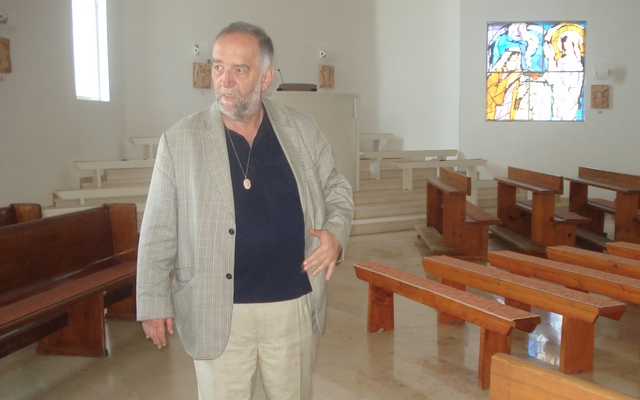
The church served as a hospital during the tragic conflict between two victims – Croats and Muslims in central Bosnia.
Both were the victims of the Serbian aggression. Photo by D.(R).
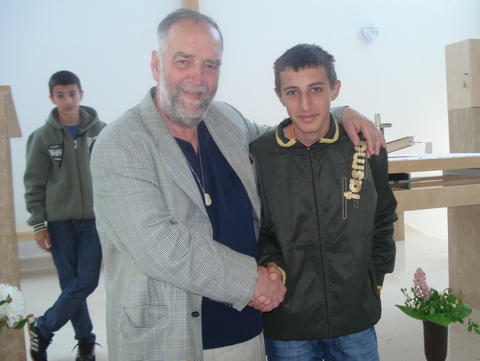
About 4000 children from different nationalities and religious affiliations was born in the course of five years,
between 1995 and 2010. Photo by D.(R).
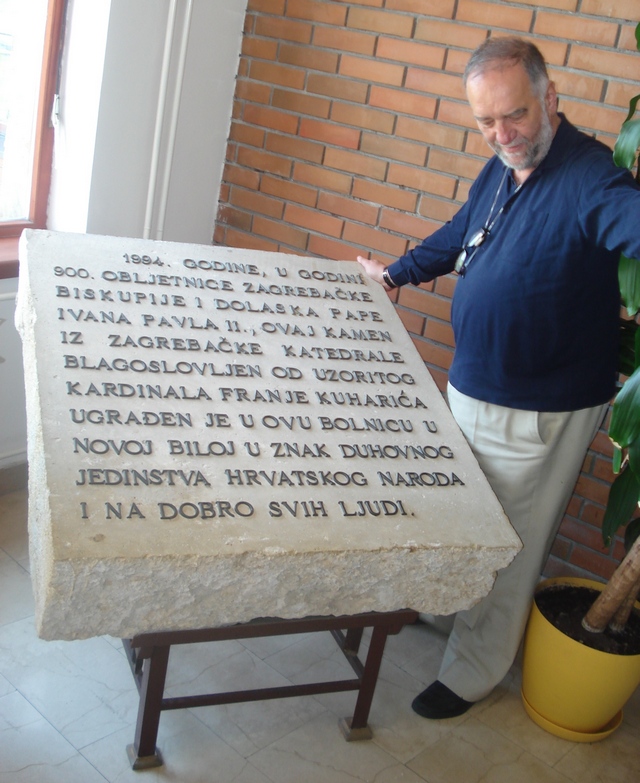
Near the main entrance is the stone on the photo, previously a part of the Zagreb Cathedral, consecrated by late archbishop dr. Franjo Kuhariae in Zagreb.
The inscription calls for the hospital to be a sign of unity of Croatian people and to serve for wellbeing of everybody.
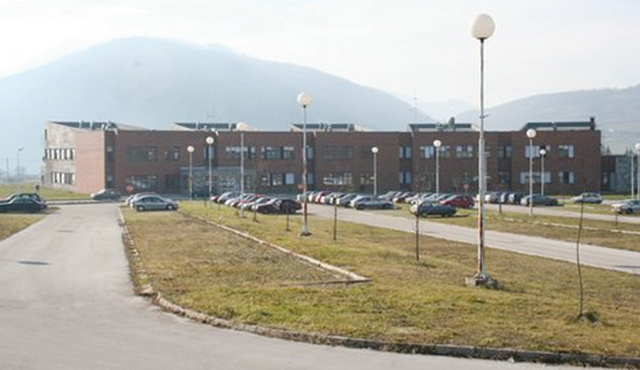
The idea to build the Nova Bila Hospital has been proposed by dr. Slobodan Lang in 1994.
The project has been financed by Croatia, and the hospital serves to all citizens,
regardless of national or religious affiliation.

The trademark of the Nova Bila Hospital on the left has been conceived by dr. Slobodan Lang.
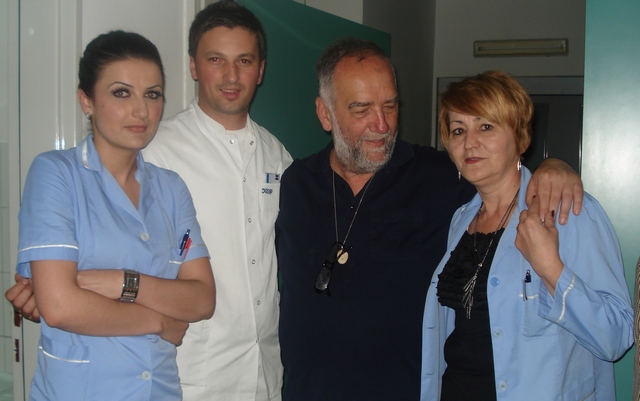
Dr. Slobodan Lang with a part of the stuff of the Nova Bila Hospital.

Dr. Slobodan Lang in front of the famous Nova Bila church, which served as a hospital.
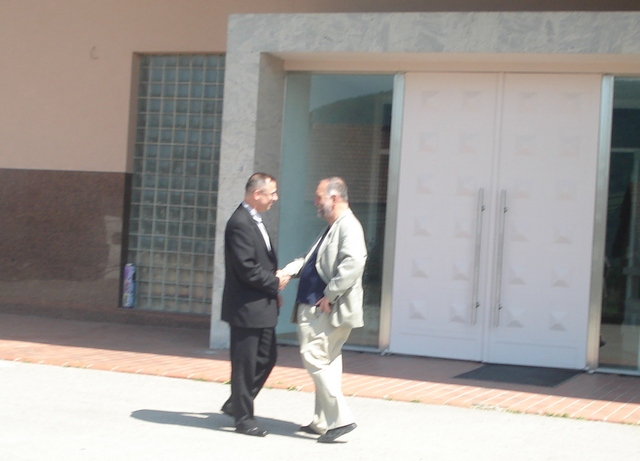
| Zoran Kupre1kiae and Slobodan Lang meeting in front of the church in Nova Bila. Mr. Kupre1kiae spent more than four years innocent in the Hague prison, about which he wrote the book Ha1ka priea (The Hague Story) in Croatian. It is indeed surprising that neither Mr. Kupre1kiae nor his family did not obtain even an apology from the United Nations. Mr. Kupre1kiae reported about his four years’s martyrdom in the Hague in his lecture at the international conference “The Passion of Bosnia and Herzegovina”, organized in Vitez in BiH. Dr. Slobodan Lang was also one of the lecturers. Photos by D.(R). 2010. |
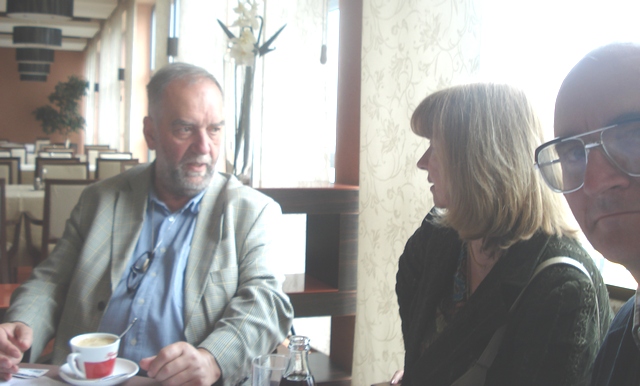
Dr. Slobodan Lang with Marija (C)ereme1iae from Baeki Mono1tor in Vitez
at the international conference “Passion of Bosnia and Herzegovina”. Photo by D.(R).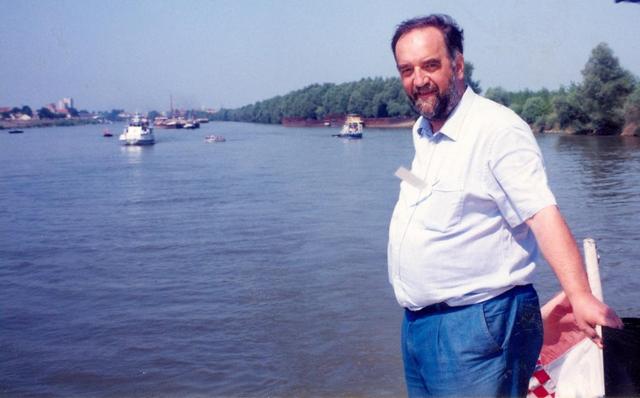
Dr. Slobodan Lang on the Danube river, during the peaceful reintegration of occupied parts of Croatia in 1998.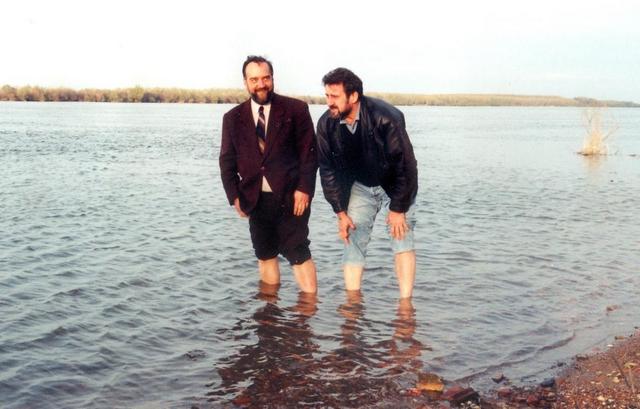
Dr. Slobodan Lang celebrating the peaceful reintegration of the occupied Danube region into Croatia in 1998.
Photos by the courtesy of dr. Lang.
| A, Slobodan Lang: Challenge of Goodness: Twelve Humanitarian Proposals Based on the Experience of 1991-1995 Wars in Croatia and Bosnia and Herzegovina [PDF1] [PDF2], Croatian Medical Journal, Vol 39, No 1, 1998 Source Croatian Medical Journal, part 1, part 2 |
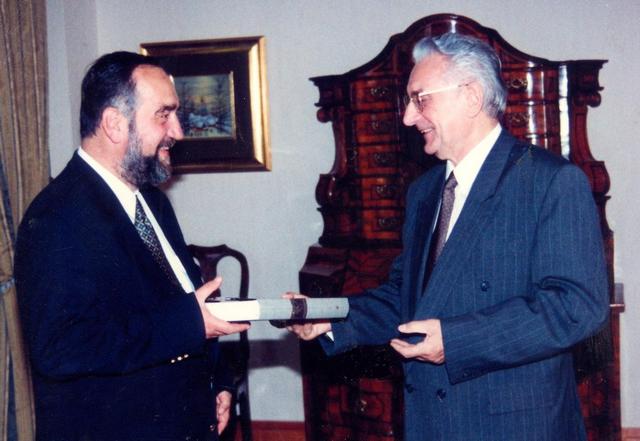
Dr. Slobodan Lang with president dr. Franjo Tudman in Zagreb.
Dr. Lang was the advisor of president Tudman for humanitarian issues. Photos by the courtesy of dr. Lang.
www.zdravi-gradovi.com.hr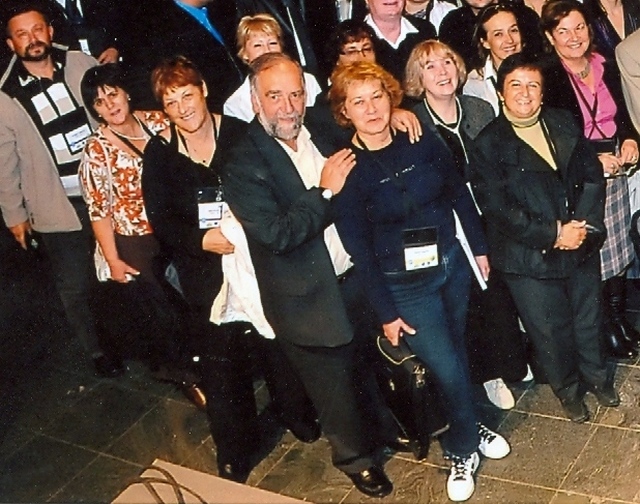
Photos by the courtesy of dr. Lang.
The International Healthy Cities Conference in Zagreb in 2008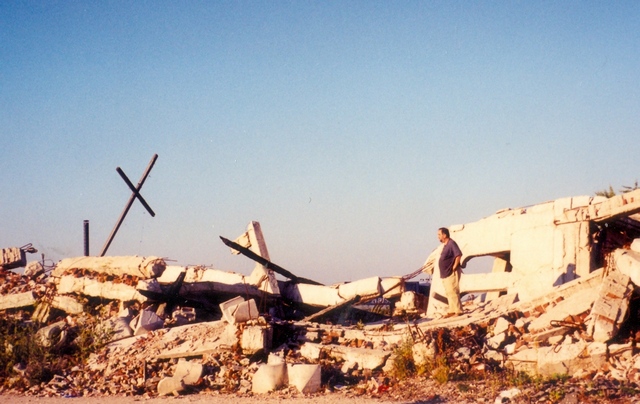
Dr. Slobodan Lang on the runins of the Catholic church in Kupres in Bosnia and Herzegovina,
destroyed during the Serbian aggression. Photo by the courtesy of dr. Lang.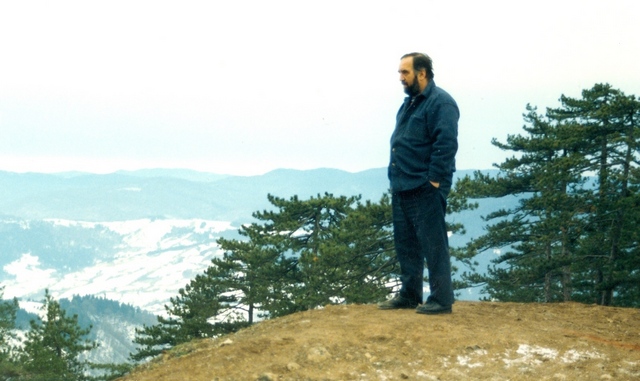
Dr. Slobodan Lang on a mountain in Bosnia and Herzegovina. Photo by the courtesy of dr. Lang.
Formated for CROWN by prof.dr. Darko (R)ubriniae
Distributed by www.Croatia.org . This message is intended for Croatian Associations/Institutions and their Friends in Croatia and in the World. The opinions/articles expressed on this list do not reflect personal opinions of the moderator. If the reader of this message is not the intended recipient, please delete or destroy all copies of this communication and please, let us know!