| Sead Muhamedagiae âEURžIch A 1/4 bersetze, also bin ichâEURoe FA 1/4 r sein Meisterwerk, die Übersetzung von Thomas Bernhards Roman âEURžAuslA?schung. Ein ZerfallâEURoe, wurde Sead Muhamedagiae 2012 mit dem kroatischen Staatspreis âEURžIso VelikanoviaeâEURoe ausgezeichnet. In der Lobrede zur Preisverleihung heiAYt es: Sead Muhamedagiae verfA 1/4 gt A 1/4 ber geraume Erfahrung in der Übersetzung von Versen und deshalb enthA¤lt seine Übersetzung von Bernhards Roman zahlreiche sprachliche Finessen und erklingt wie eine Symphonie. Ein erfahrener und guter Übersetzer, der mit den kleinsten Einzelheiten des Romankontextes und der kroatischen Sprache vertraut ist, hat das bedeutendste und umfangreichste Werk eines der grA?AYten A?sterreichischen Schriftsteller A 1/4 bersetzt. Geboren wurde Sead Muhamedagiae 1954. In Zagreb schloss er sein Studium der Germanistik ab, wo er als LiteraturA 1/4 bersetzer, Publizist und Dichter lebt. Er A 1/4 bersetzt Belletristik, Lyrik, Essays, literatur- und musikwissenschaftliche Texte sowie pA¤dagogische Schriften aus dem Deutschen und Kroatischen. Neben Thomas Bernhard A 1/4 bersetzte er Werke deutschsprachiger Autorinnen und Autoren wie Elfriede Jelinek, Annemarie Schimmel, Werner Schwab, Arthur Schnitzler, Peter Turrini, Karl Kraus, Gert Jonke, Klaus Hensel und W. G. Sebald. FA 1/4 r seine A 1/4 bersetzerischen Leistungen wurde Sead Muhamedagiae mit zahlreichen Preisen ausgezeichnet. Q. Mit Hofmannsthals Chandos-Brief, einem Text A 1/4 ber die Sprach- und Kulturkrise um die Jahrhundertwende, fing alles an. Herr Muhamedagiae, ist der erste Text fA 1/4 r einen Übersetzer entscheidend und wie geht ein Übersetzer mit eventuellen Sprachkrisen um? A. Hofmannsthals Chandos-Brief ist ein kleines Meisterwerk. Von seiner stilistischen PrA¤gnanz bin ich auch heute noch fasziniert. Vor zwA?lf Jahren hatte ich wieder Gelegenheit, mich meines âEURžErstlingsâEURoe noch einmal anzunehmen. Es gab nA¤mlich Textstellen, die noch âEURžgeschliffenâEURoe werden sollten. Als Übersetzer hatte ich mit der Sprachkrise keinerlei Schwierigkeiten. Ich hatte vor einigen Jahren eine andere Krise zu bewA¤ltigen, die ich als altersbedingten Motivationsmangel bezeichnen wA 1/4 rde. Warum soll ich denn nur Werke anderer Autoren A 1/4 bersetzen? WA¤re es nicht sinnvoller, eigene Texte zu verfassen? Nach langem Sinnieren gelangte ich schlieAYlich zur Erkenntnis, daAY ich erstaunlicherweise imstande bin, Meisterwerke unterschiedlicher Autoren so zu A 1/4 bertragen, daAY sie auch als Übersetzungen als solche wahrgenommen werden. Und da ich bereits am Anfang meiner A 1/4 bersetzerischen Laufbahn mit einem A 1/4 beraus anspruchsvollen Text konfrontiert war, weiAY ich sehr wohl, daAY der Chandos-Brief fA 1/4 r mich der bahnbrechende Schritt auf diesem abenteuerlichen Weg war. F. Der Leitsatz âEURžIch A 1/4 bersetze, also bin ichâEURoe stammt aus Ihrem Interview mit dem Innsbrucker Schriftsteller Alois Hotschnig. Wie stark beeinflusst das Übersetzen Ihre Existenz? A. Das Übersetzen macht mir die materielle Existenz mA?glich. Da ich als freischaffender LiterarÜbersetzer (ich mag diesen patinierten Ausdruck sehr!) tA¤tig bin und ausschlieAYlich von Übersetzerhonoraren lebe, ist diese Existenz alles andere als sicher. Hinzu kommen meine spezifischen Lebenskosten, die mit meiner Sehbehinderung (Vollblindheit) und mit damit zusammenhA¤ngenden, leider auch sehr teueren Hilfsmitteln verbunden sind. Andererseits gestaltet sich meine Existenz nach eigenartigen GesetzmA¤AYigkeiten, durch die sich das Übersetzen fA 1/4 r mich als eine A 1/4 beraus kreative Lebensstrategie ergibt, derzufolge das Übersetzen als vielschichtige Weltdeutung fA 1/4 r mich viel mehr als bloAYe Übertragung eines literarischen Textes in eine andere Sprache darstellt. âEURžIch A 1/4 bersetze, also bin ich!âEURoe ist daher keine pathetische Floskel, sondern eine tA¤glich gelebte Lebenserfahrung. F. A-sterreichische Autorinnen und Autoren scheinen es Ihnen besonders angetan zu haben. Was fasziniert Sie an der A?sterreichischen Literatur? A. Ingeborg Bachmann betont in ihren essayistischen Texten die Wichtigkeit der Bestrebung eines Autors, daAY seine geschriebenen SA¤tze als âEURžwahre SA¤tzeâEURoe aufgefaAYt werden kA?nnen. In der neueren A?sterreichischen Literatur gibt es mehrere Autoren, fA 1/4 r die die Wahrheit (VergangenheitsbewA¤ltigung, Gesellschaftskritik, A?ffentliches Engagement usw.) im Mittelpunkt ihres literarischen Schaffens steht. Da ich auch die von Nietzsche formulierte Erkenntnis hinsichtlich der Giftigkeit verschwiegener Wahrheiten als SchlA 1/4 ssel zum Verstehen der durch die globale Orientierungslosigkeit erschA 1/4 tterten Jetztzeit erachte, A 1/4 bersetze ich besonders gerne alle Autoren, deren Werke von solchem Gedankengut durchdrungen sind (Kraus, Kramer, Bernhard, Kappacher, Handke, Turrini, Jonke, Mitterer, Jelinek, Laher, Fian, Schwab, Hotschnig, Wogrolly). F. Sie haben Bernhards gewaltigen Roman âEURžAuslA?schungâEURoe ins Kroatische A 1/4 bersetzt. Wie war die Übersetzungsarbeit an diesem Roman oder was wA 1/4 rden Sie als die grA?AYte Herausforderung beschreiben? A. Bei der Übersetzung von AuslA?schung haderte ich in der ersten Arbeitsphase mit dem fA 1/4 r Thomas Bernhard so spezifischen Satzrhythmus. Nach etwa einem Drittel war ich mir diesbezA 1/4 glich meiner Sache sicher, weil ich die formale Zwanglosigkeit der kroatischen Syntax nicht mehr als stilbezogene GefA¤hrdung zu miAYdeuten trachtete. Ein anderes Problem war die Frage, ob ich als Übersetzer der ungeheueren Übertreibungskunst des Autors gerecht werde. Der mir bis dato nicht so vertraute Polemiker in mir konnte mir dabei eifrig behilflich sein. Stellenweise hatte ich eruptive Lust, mit dem Autor zu streiten. Es gab aber auch solche Stellen, wo ich als infizierter Übertreibender noch mehr eigenen Senf dazu geben wollte, was ich selbstverstA¤ndlich unterlassen habe. Ich fA 1/4 hlte nA¤mlich, daAY sich durch diese spannungsreiche Arbeit in mir so manche wuchtigen Energien freisetzten, die mich mA?glicherweise zum Schreiben anspornen werden. F. Gab es Momente, in denen Sie den mit zahlreichen Wiederholungen und Übertreibungen durchsetzten inneren Monolog des ErzA¤hlers in âEURžAuslA?schungâEURoe satt hatten? A. Wiederholungen und Übertreibungen kannte ich als kennzeichnende Stilmittel bei Bernhard sehr gut. Wiederholungen liebe ich als Musikliebhaber genauso wie er. Übertreibungen motivierten mich zum steten und emsigen Mitdenken, das A 1/4 ber das beim Übersetzen A 1/4 bliche analytische Nachdenken weitgehend hinausgeht, sodaAY meine Arbeit wA¤hrend der zehn Übersetzungsmonate keinesfalls monoton war. F. In der Arbeitsgruppe Kroatisch-Deutsch nannten wir einige Schwierigkeiten, die uns das Kroatische fA 1/4 r die Übersetzung ins Deutsche bereitet, wie z. B. Partizipien, der Verbalaspekt, die richtige Vergangenheitsform fA 1/4 r das kroatische Perfekt, LehnwA?rter deutschen Ursprungs, Serbismen, Turzismen, Kroatismen und vieles mehr. Wie sieht das umgekehrt aus? Welche sprachlichen Besonderheiten des Deutschen sind fA 1/4 r Sie schwer oder vielleicht auch nur unbefriedigend ins Kroatische zu A 1/4 bersetzen? A. Die grA?AYten Schwierigkeiten empfinde ich als Übersetzer auf der semantischen Ebene. Als Beispiel nenne ich die WA?rter, die mit dem Wortstamm âEURžmutâEURoe zusammenhA¤ngen. Das launische âEURžGemA 1/4 tâEURoe gehA?rt natA 1/4 rlich ebenfalls dazu. Und wenn ich dann jemandem âEURžetwas zumutenâEURoe soll, verstricke ich mich in âEURžVermutungenâEURoe, âEURžMutmaAYungenâEURoe usw. Ein anderes Problem stellt der gute alte âEURžGeistâEURoe dar, und zwar nicht nur fA 1/4 r Theologen und Philosophen, sondern auch fA 1/4 r uns LiterarA 1/4 bersetzer. Da muAY ich aber schon aufhA?ren, damit dies nicht in einer nicht enden wollenden Antwort ausartet. F. Herr Muhamedagiae, was fA 1/4 r ein GefA 1/4 hl ist es, eigene Übersetzungen zu lesen? Sind Sie in der Regel mit Ihren Übersetzungen zufrieden oder wA 1/4 rden Sie nach einiger Zeit gerne A,,nderungen vornehmen? A. Passagenweise ist es oft schA?n, in der eigenen Übersetzung zu lesen. Besonders schA?n ist es, wenn du als Leser fA 1/4 r einen Augenblick vergiAYt, daAY es deine eigene Übersetzung ist, weil dich der literarische Gehalt des Werkes hingerissen hat. Meinen eigenen Übersetzungen stehe ich zugleich selbstkritisch und selbstbewuAYt gegenA 1/4 ber. Ich wA 1/4 rde immer gerne von der MA?glichkeit Gebrauch machen, an meiner bereits publizierten Übersetzung noch ein biAYchen zu feilen, aber ich weiAY ebenfalls, daAY es in meinen Übersetzungen Stellen gibt, die mir infolge mancher gA 1/4 nstigen, durch geeignete AusdrucksmA?glichkeiten der Zielsprache bedingten UmstA¤nde besonders gut gelungen sind. Je tiefgreifender man ein literarisches Werk erfaAYt, umso deutlicher wird es dem Übersetzer, wie qualitA¤tsvoll oder wie mangelhaft dessen Widerhall in der Zielsprache ist. F. Eines der Ziele des Projekts TransStar ist es, ein breites Publikum fA 1/4 r kleine Sprachen und Kulturen zu sensibilisieren. Gibt es Werke kroatischer oder auch anderer sA 1/4 dslawischer Autoren, die Sie den deutschen VerlagshA¤usern empfehlen wA 1/4 rden? Welchen zeitgenA?ssischen Autor wA 1/4 rden Sie gerne ins Deutsche A 1/4 bersetzen? A. Mit Nachdruck mA?chte ich in diesem Zusammenhang betonen, daAY es keinerlei âEURžkleine SprachenâEURoe und âEURžkleine KulturenâEURoe gibt. Ich muAY mich jetzt bremsen, um nicht vom âEURžkulturellen ImperialismusâEURoe zu sprechen, wobei ich mich gar nicht der Bernhardschen Übertreibungsmunition zu bedienen brA¤uchte. Aber jetzt zur Sache: Ich wA 1/4 rde mich als Übersetzer besonders gerne mit dem Schaffen des kroatischen Dichters und Literaturwissenschaftlers Kre1imir Bagiae (1962) befaAYen. Als Übersetzer wA 1/4 rde ich diesem ausgezeichnet schreibenden Autor viele passende MA?glichkeiten des Deutschen als Zielsprache veranschaulichen, wodurch auch er am Gelingen meiner Übersetzung seiner Gedichte und Essays konstruktiv mitwirken kA?nnte. Diese noch zu entdeckende Vorgehensweise schwebt mir als richtungsweisende Strategie vor, die zur intensivierenden FA?rderung aller kA 1/4 nftigen A 1/4 bersetzerischen BemA 1/4 hungen ausschlaggebend beitragen sollte. Ich als leidenschaftlicher Liebhaber (= Philologe) des Deutschen glaube nA¤mlich gar nicht an das Dogma des sogenannten âEURžMuttersprachlersâEURoe. Das ist ein philologisch suspekter Irrweg der Translationswissenschaft und der gA¤ngigen Beurteilungspraxis. Die Sprache ist viel mehr als der jeweilige sprachliche Code, in welchen ein herkA?mmlicher Zeitgenosse hineingeboren wird. Ich vergleiche hierzu die Sprache mit der Orgel und mA?chte gerne alle mir zur VerfA 1/4 gung stehenden Register dieser begnadeten KA?nigin des Wohlklangs beliebig ausprobieren. Herr Muhamedagiae, vielen Dank fA 1/4 r Ihre inspirierenden Antworten. von Ines Hudobec, Vivian Kellenberger und Daniela Eanear Source transstar-europa.com |
Sead Muhamedagiae âEURžI translate, therefore I amâEURoe In 2012 Sead Muhamedagiae was awarded the Croatian national price âEURoeIso VelikanoviaeâEURoe for his masterpiece, the translation of Thomas BernhardâEUR(TM)s novel Extinction. The eulogy for the award ceremony states: Sead Muhamedagiae possesses ample experience in translating verse and consequently his translation of BernhardâEUR(TM)s novel contains great linguistic finesse and resounds like a symphony. An experienced and good translator, who is familiar with the smallest of detail of the novel context and the Croatian language, has translated one of the most relevant and extensive works of one of the greatest Austrian authors. Sead Muhamedagiae was born in Zagreb in 1954, where he completed his degree in German Studies and to this day lives as a literary translator, journalist and poet. He translates fiction, poems, essays, scholarly texts on literature and music as well as pedagogical texts from German into Croatian. In addition to Thomas Bernhard he also translates works of German-language authors such as Elfriede Jelinek, Annemarie Schimmel, Werner Schwab, Arthur Schnitzler, Peter Turrini, Karl Kraus, Gert Jonke, Klaus Hensel and W.G. Sebald. He has been awarded a number of prices for his achievements in translation. Q. Everything began with the Chandos letter by Hofmannsthal, a text about the linguistic and cultural crisis around the turn of the century. Mr. Muhamedagiae, is the first text decisive for a translator and how does a translator deal with possible linguistic crises? A. HofmanthalâEUR(TM)s Chandos letter is a little masterpiece. Still today I am fascinated by its stylistic conciseness. Twelve years ago I had the opportunity again to minister to my âEURoefirstlingâEUR once more. There were text passages that still needed to be âEURoerefinedâEUR. As a translator I have no problems with the linguistic crisis at all. A few years ago I had to overcome another kind of crisis, which I would refer to as an age-related lack of motivation. Why should I only translate the works, of other authors? Would it not make more sense to write my own texts? After extensive contemplation I realized that I am surprisingly capable of transmitting the masterpieces of a diversity of authors in such a way so that they are recognized as such, even as a translation. And since from the beginning of my career path as a translator I was confronted with a very demanding text, I am very well aware of the fact that the Chandos letter was a groundbreaking step for me on this adventurous path. Q. The principle statement âEURžI translate, therefore I amâEURoe stems from your interview with the Innsbruck author Alois Hotschnig. How strongly does translation influence your existence? A. Translation ensures my material existence. Since I am active as a freelance literary translator (LiterarÜbersetzer âEUR” I really like this patented expression!) and live exclusively from honoraria I get for translating, this existence is everything but secure. To that one needs to add my specific costs of life, which are unfortunately very high as a result of my visual impairment (full blindness) and associated aids. On the other hand, my existence adheres to unique set of rules through which translation for me turns into an extremely creative strategy of living as a result of which translation is much more than a mere transferral of literary text into another language; for me it becomes a complex interpretation of the world. âEURžI translate, therefore I am!âEURoe is thus not pathetic verbiage but an experience I live every day of my life. Q. You seem to be taken by Austrian authors. What fascinates you with Austrian literature? A. Ingeborg Bachman emphasizes in her essayist texts that it is important for authors to aim towards writing sentences that can be considered as being âEURoetrue sentencesâEUR. In modern Austrian literature there are a number of authors for whom truth (the process of coming to terms with the past, social critique, public engagement) remains at the centre of their literary activity. Since I also consider the perception formulated by Nietzsche that the poisonous nature of truths which remain unsaid as key in being able to understand the present, which has been devastated by a global disorientation, I especially enjoy translating all authors whose work is penetrated by such ideas (Kraus, Kramer, Bernhard, Kappacher, Handke, Turrini, Jonke, Mitterer, Jelinek, Laher, Fian, Schwab, Hotschnig, Wogrolly). Q. You have translated BernhardâEUR(TM)s enormous novel âEURžExtinctionâEURoe into Croatian. What was it like translating this novel or what would you consider to be the greatest challenge? A. In the first phase of translating Extinction I had a hard time with the rhythm of the sentences so specific to Thomas Bernhard. After about one third I became more confident in this regard because I was not afraid of misinterpreting the formal unconstraint of the Croatian syntax as a style-related threat. Another problem was the question whether I as translator can adequately recreate the enormous art of exaggeration of the author. The polemic in me, which I had until this time not been familiar with, was able to eagerly help me out with this. In passages the want erupted in me to start arguing with the author. There were however other passages where I, as one who had become infected with exaggeration, wanted to add my own two cents, which I of course refrained from. I felt as though that through this intense work massive energies were released inside of me which possibly stimulated me to write. Q. Were there moments in which you were tired of the inner monologue of the narrator in âEURžExtinctionâEURoe which is interspersed with numerous repetitions and exaggerations? A. Repetition and exaggeration I was very familiar with as a characteristic style of Bernhard. As a music aficionado I love repetition just as much as he does. Exaggeration motivates me to continue to diligently think which goes way beyond the analytical thinking typical for translation so that my work during the ten months of translation were everything but monotonous. Q. In the working group for Croatian-German we identified a few difficulties that go along with translating the Croatian language into German such as for instance participles, the verbal aspect, correct past tense form for the Croatian perfect, loanwords of German, Serbian, Turkish, Croatian origins and much more. What does it look like the other way around? What linguistic idiosyncrasies of the German language are difficult for you to translate into Croatian or translate maybe only unsatisfactorily? A. As a translator I find the greatest difficulties to be on the semantic level. For example I would like to mention the words that are connected to the root âEUR”mut (courage). The capricious GemA 1/4 t (temper) is clearly also part of it. And if I should zumuten (expect) something of somebody then I get involved in Vermutungen (assumptions), MutmaAYungen (speculations), and so on. Another problem is posed by the good old âEURoespiritâEUR, and not only for theologians and philosophers but also for us literary translators. However, here I should stop so that this does not end up being a never-ending answer. Q. Mr. Muhamedagiae, what does it feel like to read your own translation? Are you generally happy with your translations or would you like to modify your translations after some time? A. It is often nice to read passages of your own translation. It is especially nice if as a reader one forgets for a moment that it is oneâEUR(TM)s own translation because one is taken by the literary content of the text. My own translations I am able to regard with self-confidence and self-criticism. I would always like to take advantage of the opportunity to refine my translations which have already been published, but I also know that in my translations there are passages I translated especially well as a result of some ideal circumstances due to suitable possibilities of expression contingent on the target language. The more deeply one captures the literary work, the more obvious it becomes to the translator how high-quality or how insufficient reverberations are in the target language. Q. It is one of the goals of the TransStar project to sensitize a broader audience to small languages and cultures. Are there works of Croatian or other South Slavic authors that you would like to recommend to German publishing houses? Which contemporary author would you like to translate into German? A. In this context would like to emphasize that there are no âEURžsmall languagesâEURoe and no âEURžsmall culturesâEURoe whatsoever. I now have to refrain from speaking of âEURžcultural imperialismâEURoe whereby I would not be necessary for me to rely on the ammunition provided by the Bernhardian exaggeration. But to get to the point: As a translator I would especially like to work with the work of the Croatian poet and literary scientist Kre1imir Bagiae (1962). As a translator I would like to demonstrate to this author, who writes so outstandingly, many appropriate capabilities of German as a target language as a result of which he could also constructively contribute to the success of my translating his poems and essays. This approach, which has not been discovered yet, I envision to be a potential trend-setting strategy which should considerably contribute to the increased advancement of all future translating activities. I as a passionate enthusiast (= philologist) of the German language do not believe in the dogma of the so-called native speaker. This is a philologically suspect maze of the translation sciences and the typical practice of assessment. Language is much more than a particular linguistic code in which a conventional contemporary is born into. For this I will compare language with the pipe organ and would like to randomly try out all registers of this exceptionally gifted queen of melodiousness available to me. Mr. Muhamedagiae, thank you for your inspiring anwers. by Ines Hudobec, Vivian Kellenberger and Daniela Eanear Source transstar-europa.com |

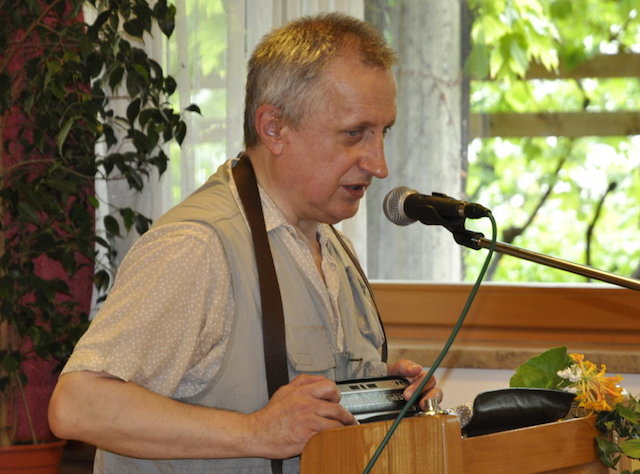
describing them his daily work and the Braille Script, using electronic equipment for blind. Photos by Gerald HA 1/4 hner.

Sead Muhamedagiae is a member of Society of Croatian Literary Translators (Dru1tvo hrvatskih knji 3/4 evnih prevodilaca)
Sead Muhamedagiae can be contacted via his e-mail:
[email protected]
| Â Predavanja u Grazu u Austriji Sead Muhamedagiae predaje na njemaekom jeziku kao vanjski suradnik na Visokoj pedago1koj 1koli u (C)tajerskoj u Grazu, Austrija (PA¤dagogische Hochschule Steiermark in Graz). Njegovi kolegiji su bili izborni, a zvali su se:
Gostuje po pozivu u raznim udrugama i 1kolskim institucijama. Tako je na pr. na Filozofskom fakultetu Sveueili1ta u Zadru godine 2017. za studente filologije odr 3/4 ao predavanje o prevodenju pod naslovom “Prevodim, dakle jesam – Iskustva slijepog prevodioca”, a za studente germanistike na njemaekom pod naslovom “Literatur und Wahrheit” (= “Knji 3/4 evnost i istina”). |
Lectures in Graz in Austria Sead Muhamedagiae lectures in German language as outside collaborator at the High Pedagogical School for Steiermark in Graz, Austria (PA¤dagogische Hochschule Steiermark in Graz). His courses were elective, consisting of
Upon invitation, he is a guest at verious NGO-s and school institutions. For example, in 2017, at the Faculty of Philosophy of the University of Zadar, he had an invited lecture for students of philology entitled “I translate, hence, I am – Experiences of a blind translator”, and for the students of German studies he delivered a lecture in German language entitled “Literatur und Wahrheit” (= “Literature and Truth”). |
| Â Laieke kolumnice Seada Ivana Muhamedagiaea Manje je vi1e (Laieka kolumnica [89]) Srce ti dajem! Formativnu idilienost bo 3/4 iaenog vremena prvi sam put do 3/4 ivio kao znati 3/4 eljan sedamnaestogodi1njak. Unatoe tmurnim oblacima na politiekom obzorju uslijed brutalna ga1enja onodobne hrvatske âEURžproljeaearskeâEURoe baklje, u skrovitosti toplog ozraeja zagrebaeke crkve tada jo1 bla 3/4 enoga Marka Kri 3/4 eveanina, u kojoj je du1obri 3/4 nieki i za mnoge oeinski djelovao nezaboravni sveaeenik Franjo Jurak, zbio se moj prvi preobrazbeni Bo 3/4 iae. Euo sam tada i zavolio kanon hrvatskih bo 3/4 iaenih popijevaka, a jedna od njih blago mi se urezala u prijemeiv daeki um, u kristozovno katekumensko srce. Kad sam godinu dana kasnije u knji 3/4 nici 1kole âEURžVinko BekâEURoe prigu1eno zasvirao na elektrienom harmoniju, najprije su odjeknuli taktovi pjesme Djete1ce nam se rodilo, a u njezinu pripjevu ba1 danas otkrivam naslovni usklik novogodi1nje kolumnice. Pjevajuaei tako s narodom Bo 3/4 jim tu djetinjom priprosto1aeu natopljenu pjesmu, nenadano mi se obznanila aeutilna sr 3/4 njezine konfesorske poruke: Srce ti dajem…! = credo! âEUR” Vjerujem! Â Â Â Â Â Â (R)iva je vjera duhovno blago ustreptala srca koje neumorno i ravnomjerno ni 3/4 e na1e 3/4 ivotvorne otkucaje. O svagda obnovljivoj kakvoaei tih tankih vjeroniti nedvojbeno ovise o1trost i mekoaea slamice u jaslicama srca u koje je polo 3/4 eno Djete1ce 1to se o Bo 3/4 iaeu opetovano rada u svakom od nas tko to uzmogne dopustiti. Za razliku od krhkim eovjekovim znanjem programiranih ideologija koje ovaj usrdni refren lako mogu preinaeiti tako da mo 3/4 ebitno glasi: Um svoj ti dajem..., vi1nji nam Bog to nadasve privlaeno prostranstvo inventivna ljudskog uma s punim povjerenjem u na1u odgovornost i domi1ljatost milostivo prepu1ta kao primjeren prostor ma1tovita oblikovanja potpuno slobodne volje, po kojoj bez prisile donosimo, preispitujemo i ozbiljujemo sve svoje odluke. Â Â Â Â Â Â Davanje i primanje stamen su temelj kako na1ih vremenitih meduljudskih odnosa tako i bezvremenske povratne sprege (= lat. religio) izmedu Boga i eovjeka. Neka nas u Novoj godini poput provodnog motiva prate iskrene pripjevne rijeei iz ljupke bo 3/4 iaene popijevke kao vedro smjerokazno jamstvo postojanosti na putu u bolju buduaenost. Sead Ivan Muhamedagiae Manje je vi1e (Laieka kolumnica [90]) Vjera kao pjesma Poznajem mnoge ljude iz eije se nutrine damonice zrcali nadahnjujuaea isprepletenost jezgrovitih imenica koje su se zdru 3/4 ile u kolumniekom naslovu. Neposredan povod da se njime ba1 sada poslu 3/4 im netom je objavljena, formom i sadr 3/4 ajem osebujna monografija posveaeena ansamblu koji je stotinama elanova, meni i nekolicini na1ih 3/4 upljana svojedobno tvorio duhovni okvir cjelovita vjerniekog sazrijevanja. Vjera kao pjesma âEUR” Collegium pro musica sacra uz 45 godina djelovanja âEUR” naslov je znalaeki saeinjene knjige koja aee javnosti biti predstavljena za nekoliko tjedana. Uz odobrenje autora/priredivaea (don Anton (C)uljiae) i umjetnieke voditeljice ansambla (sestra Cecilija Ple1a) ushiaeeno dijelim sa eitateljstvom 3/4 upnog listiaea iskrenu radost i golemu zahvalnost dragom Bogu i dobrim ljudima s kojima me uz prisno prijateljstvo povezuju formativne vrednote kojima je pro 3/4 eta neprolazna musica sacra. Vjera i pjesma ljupke su dvorkinje srca. Grijane njegovom toplinom, medusobno se pro 3/4 imaju. (C)to vjera proniknuaeem dosegne, to pjesma smjerno otpjeva. Dok se promuaeurni um oko vjere mudrujuaei dvoumi, pose 3/4 uaei za pjesmom radi prolazna u 3/4 itka i ubrzana opu1tanja, srce se onkraj zakueastosti sofisticirane logike i usprkos otu 3/4 nosti olovnih vremena rado puni vjerom. A eega je puno, srce o tome zbori i s vjerom bogozovno pjeva! Pjesma je, reee Augustin, dvostruka molitva. Molitva je pak svagda no1ena vjerom koja se, kako nas pouei1e drevni Tertulijan i razboriti Akvinac, ne spotiee ni onda kad je netremice zaskoei nedokazni apsurd iliti besmislica. Tajnoviti koloplet vjere i pjesme duhovno je ozraeje o kojemu svjedoei spomenuta knjiga. Vjerujem da aee se u tome donekle prepoznati i elanovi slienih ansambala. U tome vjeropjevnom vrtlogu dinamieno se odvija i moj vlastiti 3/4 ivot. Kad vjera pavlovski premje1ta brda, pjesma im eudesno oduzima te 3/4 inu. Tim gotovo posve neistra 3/4 enim suodnosom ljekovite uzajamnosti pjesme i vjere valja nam se 1to vi1e baviti, a pjevaeki zborovi i instrumentalni sastavi kakve imamo i u na1oj 3/4 upi ponajbolja su prilika za to. Sead Ivan Muhamedagiae Manje je vi1e (Laieka kolumnica [91]) U Bo 3/4 joj kuaei Crkveni sam prag prvi put prekoraeio u proljeaee 1965. godine. Bio sam tada dak eetvrtog razreda osnovne 1kole. Iz sarajevskog Zavoda za slijepu djecu i1li smo na izlet u Jajce, a zavjetna crkva sv. Ivana Krstitelja u Podmilaeju nekim se eudom na1la na rasporedu razgledavanja grada. Nisam tada ni slutio da aeu se veae za desetak godina krstiti, ali sam u tajnovitoj polutami i sveeanoj ti1ini te po mome djetinjem poimanju Bo 3/4 je kuaee oaeutio kako me pro 3/4 imaju vreli srsi bla 3/4 ene miline poput one koja me obuzme kad na pretvorbenom vrhuncu nedjeljne euharistije zgodimice uzmognem vjernieki iskusiti 3/4 ivu Kristovu prisutnost u skrovitosti eeznutljive nutrine. Pi1em ove retke no1en 3/4 eljom da s vama neusiljeno podijelim osebujnu radost bogozovna boravljenja u Bo 3/4 joj kuaei, u âEURždomu GospodnjemâEURoe koji je stjecajem eudesnih okolnosti smje1ten u ulici u kojoj stanujem veae punih trideset godina. Aktivno molitveno i misaono sudjelovanje u svim dijelovima euharistijskog slavlja omoguaeuje brz dotok duhovne snage koja pospje1uje kolajuaee strujanje na svim 3/4 ivotnim razbojima. Pa i kad nam katkada bilo zbog rastresene zbrkanosti vlastitih misli ili uslijed neprikladna ometajuaeeg pona1anja nekolicine nepa 3/4 ljivih pojedinaca ne pode do kraja za rukom sabrati se na svetoj misi do te mjere da nas pro 3/4 me spomenuta kristovska milina, ipak aeemo u Bo 3/4 joj kuaei do 3/4 ivjeti ugodaj topline koja nas potiee na vedrije misli i suvislije zakljueke. Osim euharistijskog susreta sa 3/4 ivim Bogom do 3/4 ivljavamo u domu Gospodnjem zajednicu onih koji se rado odazivaju na poziv 1to nam ga dragi Bog neprestano upuaeuje. Svi smo odreda pozvani na svetost osmi1ljena 3/4 ivljenja u suvremenoj hrvatskoj svakodnevici. Po tome smo kao 3/4 upna zajednica odslik dinamiene Crkve koja se pod okriljem stoljetne bazilike okuplja zato da jedni drugima uprisutnjujemo trajno pamtljivo prepoznavanje trojstvenoga Boga u bli 3/4 njima iz na1eg okru 3/4 ja. Uskliknimo stoga s psalmistom: Obradovah se kad mi reko1e: âEURžHajdemo u dom Gospodnji!âEURoe (Ps 122). Sead Ivan Muhamedagiae Manje je vi1e (Laieka kolumnica [100]) Otac! Duhovni oslonac!! Ove se nedjelje, na spomendan sv. Josipa, u na1oj 3/4 upi svetkuje Dan oeeva. U nekim ga zemljama obilje 3/4 avaju prve nedjelje nakon Spasova. Ovogodi1nja kalendarska podudarnost duhovni je okvir promi1ljanja nerasvijetljene znaeajnosti oca i oeinstva 1to, neraskidivo zdru 3/4 eno s majkom i materinstvom, omoguaeuje uspostavljanje neusporedive, nezamjenjive i nenadomjestive obiteljske ugodajnosti kao prirodnog, zdravog okru 3/4 ja u kojemu se pozemljarsko bivstvovanje odvija u bogozovno osmi1ljenoj, eovjeka dostojnoj i za boljitak svijeta presudnoj punini. U mojoj dvanaestoj godini nepotkupljiva je sestrica Smrt na koju se ne trebamo srditi neumoljivo okoneala 3/4 ivot moga eestitog, Bogu odanog oca Ibrahima. Blagodati biolo1kog sinovstva koje mi katkada nedostaju naueio sam prepoznavati u oeinski milostivu djelovanju milosrdnog Boga u svome vlastitom 3/4 ivotu. Medu ljudima koje poznajem mnogo je samoprijegornih i uzornih oeeva. Premda nisam otac, osjeaeam sna 3/4 ne oeinske porive, pa usrdno molim dragog Boga da ih oblikuje i kanalizira. Nedostatak oca u djetinjstvu i mladena1tvu bolno se zrcali u ljudskim 3/4 ivotima. Braene trzavice i krize, brutalna nasilnost samo 3/4 ivih oeeva koji uslijed kojekakvih frustracija muee i zlostavljaju svoju djecu i njihove majke samo su dio nevolja koje snalaze ljudsko dru1tvo. Mnogi nezadovoljnici 1to danas bezidejno izvitoperuju postmodernu sliku svijeta produkt su globalnih obiteljskih (ne)prilika iz kojih su se suludo strmoglavili u 3/4 ivot, puni du1evnih rana i duhovnih brazgotina. Razmi1ljanje o eruptivnoj snazi i uravnote 3/4 ujuaeoj postojanosti kr1nih oeeva 1to svoje ljubavlju i milo1aeu Bo 3/4 jom pro 3/4 eto oeinstvo po uzoru na Isusova samozatajnog pooeima Josipa shvaaeaju s punom odgovorno1aeu, primjereno je korizmenom vremenu posvje1aeivanja temeljnih kr1aeanskih i opaeeljudskih vrednota. Stihovima iz antologijske pjesme Moj otac i ja zakljueak mi nudi najzagrebaekiji pjesnik Vjekoslav Majer (1900-1975): Pa aeutim, ja i moj otac, mi smo jedno
i ko da nevidljive cijevi toee krv iz njegova tijela u moje i kao da eujem klokotanje na1e krvi med zelenilom, gdje se mu1ice roje. Sead Ivan Muhamedagiae Manje je vi1e (Laieka kolumnica [105]) Glosa o sreaei Premda se imenica sreaea eesto formira na usnama, u Novom se zavjetu izrijekom ne spominje, a ni u starozavjetnim knjigama nije osobito zastupljena. To nipo1to ne znaei da se o njoj u Rijeei Bo 3/4 joj premalo govori. No1en rado1aeu 1to struji vazmenim ozraejem, kolumnieki raspredam o sreaei, jer je ona svagda tamo gdje je radost. Tragajuaei za biblijskom sreaeom, prisjeaeam se jesenas spomenutoga Rafaela. Knjiga o Tobiji obiluje zbivanjima sretna ishoda. Knjigu o Jobu, naprotiv, pro 3/4 ima turobna tjeskoba koja se netragom izgubi kad naposljetku razaberemo ogromnu sreaeu kojom Gospodin nagraduje Joba za neeuvene nevolje 1to ih je pretrpio. Starozavjetni Propovjednik o sreaei pragmatieno zakljueuje: …Prava je sreaea eovjeku jesti i piti i biti zadovoljan sa svim svojim trudom kojim se muei pod suncem za kratka vijeka koji mu je dao Bog, jer takva mu je sudbina dosudena (Prop 5,17).    U Novi je zavjet sreaea filigranski utkana onako kako je ljekovita djelatna tvar ugradena u neupitno ueinkovit, s pokriaeem skupocjen farmaceutski pripravak bez sporedna protuueinka. U iskustvenu utemeljenost ove tvrdnje smjesta se mo 3/4 e uvjeriti svatko tko se u skrovitosti bogozovne nutrine sreano i bistroumno pozabavi bla 3/4 enstvima kojima Isus zapoeinje bremenitim sadr 3/4 ajem napueenu Propovijed na gori (Mt 5, 3-12). Rastresita slojevitost biblijske sreaee ne da se zbiti u moj laieki rjeeotok. To me pak eini razdragano sretnim, jer aeu se njome na nagovor usreaeena srca jo1 koji put spisateljski pozabaviti.    U pomoae mi hrli njemaeki knji 3/4 evnik Johannes Mario Simmel (1924-2009), i na1em eitateljsstvu poznat po svojim opu1tajuaeim, humanom plemenito1aeu pro 3/4 etim romanima. On pi1e: âEURžKad bi svaki eovjek na svijetu usreaeio barem jednog drugog eovjeka, eitav bi svijet bio sretan.âEURoe    Sreaea je blago koje smo kadri tvoriti i umna 3/4 ati. Simmelov vapaj odzvanja u mome zvukozovnom slu1iku. Bo 3/4 e, blagoslovi nas, kovaee svoje sreaee! Nauei nas kako da je kujemo i nesebieno dijelimo jedni s drugima! Sead Ivan Muhamedagiae |
Formated for CROWN by Darko (R)ubriniae
Distributed by www.Croatia.org . This message is intended for Croatian Associations/Institutions and their Friends in Croatia and in the World. The opinions/articles expressed on this list do not reflect personal opinions of the moderator. If the reader of this message is not the intended recipient, please delete or destroy all copies of this communication and please, let us know!